Financial Services SEO: How to Rank in Google and AI Search Under YMYL
Financial services SEO means meeting Google's YMYL bar and your regulator's rules at once. How firms and fintechs rank and get cited.

Financial services SEO is the work of getting a finance firm found and trusted in Google and AI search while meeting a higher bar than almost any other industry: Google's Your Money or Your Life standard plus your regulator's advertising rules. Banks, lenders, insurers, wealth firms, accountants and fintech companies all face the same double test. The content has to be genuinely useful, and every claim has to survive compliance review.
The search demand is real but specific. In live DataForSEO data for the US (November 2026), "financial services seo" gets about 480 searches a month at around $17 a click, and "fintech seo" gets about 140. The people typing those are marketing leads at firms where one new client can be worth years of fees.
This guide is for owners and marketing teams at financial firms, and for the freelancers and agencies who serve them. It covers YMYL, compliance-safe content, fintech-specific tactics and how AI search changes the work.
Why is SEO harder for financial services?
Because Google treats financial content as Your Money or Your Life (YMYL) and gives extra weight to trust, while regulators restrict what firms can say. You are optimizing for a stricter algorithm and a stricter rulebook at the same time.
Google's guidance on helpful, reliable content defines YMYL as topics that could significantly affect someone's health, financial stability or safety. For those topics, Google says its systems give even more weight to content with strong E-E-A-T (experience, expertise, authoritativeness and trust), and that trust is the most important of the four.
In practice, that means anonymous articles, unsourced claims and thin AI-written explainers struggle in finance even when they would rank in other niches. Pages written or reviewed by a named, credentialed person, with dates, sources and clear disclosures, do better.
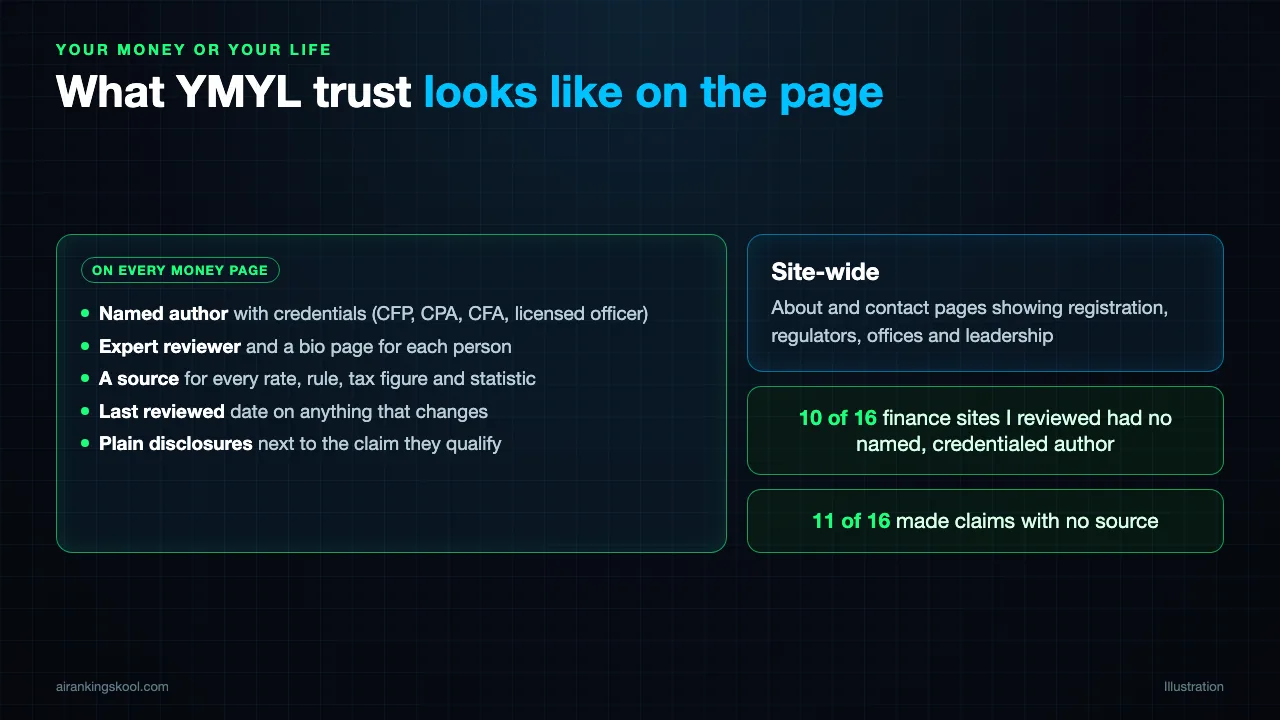
I see this in almost every finance site I review. Of about 16 finance websites I've audited, from accounting firms and mortgage brokers to a forex academy and a trading journal app, ten had no named, credentialed author behind the advice. As I told one financial planner whose advice was genuinely solid: I know you know your stuff, but Google doesn't care. It needs to see it. If I take your advice, it affects my finances, so the page has to prove who's giving it.
What does YMYL mean for your content?
Every money page needs a named expert, visible credentials, sources for each factual claim and a clear review date. Trust has to be visible on the page, not assumed.
- Author and reviewer bylines with real credentials (CFP, CPA, CFA, licensed loan officer) and a bio page for each person.
- Sources for rates, rules, tax figures and statistics, linked to the regulator, agency or primary data.
- Last reviewed dates on anything that changes, like contribution limits, rates or fees.
- Disclosures in plain language, placed near the claim they qualify rather than buried in a footer.
- About and contact pages that show a real firm: registration details, office addresses, regulators and leadership.
Which pages should a financial firm build first?
Start with one page per product or service, a page per office or region you serve, and trust pages that prove who you are. Guides and articles come after the pages that convert.
A lender needs a page for each loan type, not one "Loans" page. A wealth firm needs pages for retirement planning, tax planning and estate planning, each written for the client who searches for it. An accounting or insurance firm with several offices needs a page and a Google Business Profile for each real location, with the same name, address and phone number everywhere.
Then add the trust layer: leadership bios with credentials, regulatory and registration details, how you are paid, and how client data is protected. These are the pages a cautious buyer reads before booking a call, and they are the facts AI tools look for when deciding whether to name a firm. If you are unsure where your site stands, a full SEO audit is the fastest way to see the gaps.
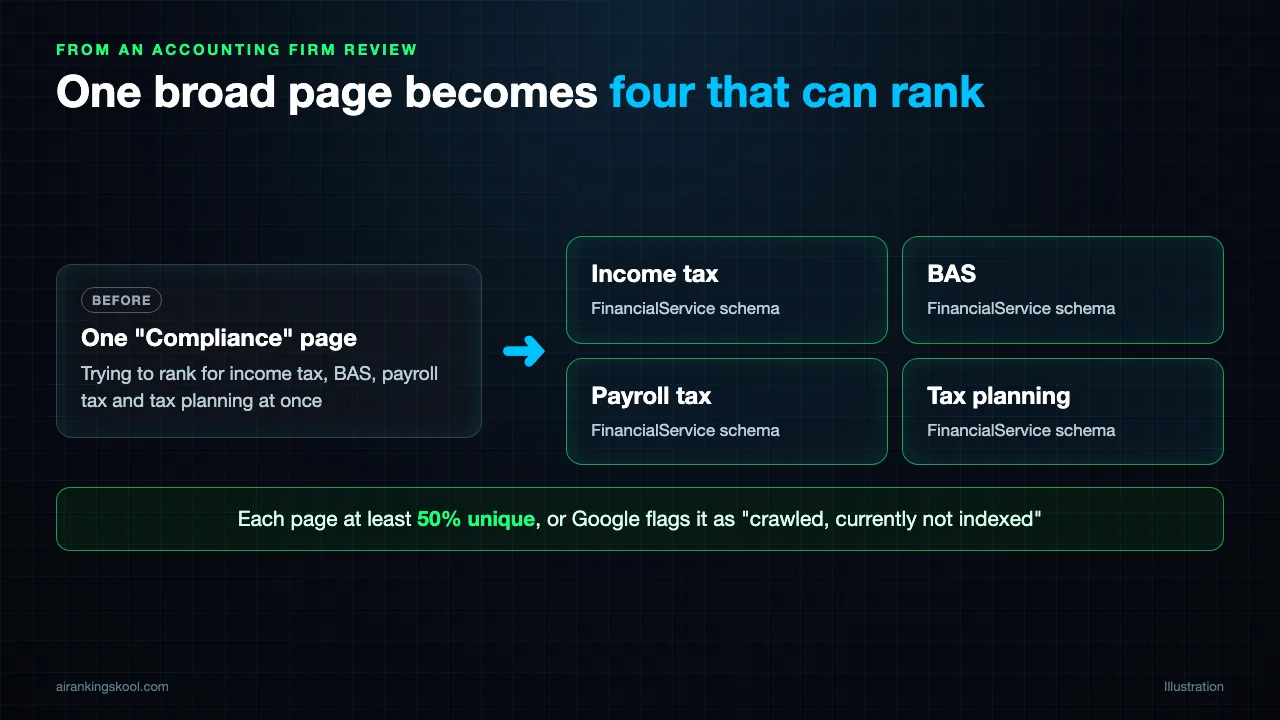
A Sydney accounting firm I reviewed had one "compliance" page trying to rank for income tax, BAS, payroll tax and tax planning at once. That's four pages, each with its own Service or FinancialService schema. The pages also need to be genuinely different. A Phoenix mortgage broker's loan pages were about 300 words each on the same template, and Search Console flagged them as crawled but not indexed. That status is Google's passive-aggressive way of saying it read the content and it wasn't good enough. Aim for at least half of each page being unique.
How do compliance rules shape financial services SEO?
Your website, blog, social posts and even AI-ready FAQ answers are marketing communications, so they must be fair, balanced and free of promissory claims. Build compliance review into the content workflow instead of bolting it on at the end.
For broker-dealers, FINRA Rule 2210 requires communications to be fair and balanced, and bans any false, exaggerated, unwarranted, promissory or misleading statement or claim. For registered investment advisers, the SEC's marketing rule (rule 206(4)-1) governs testimonials, endorsements and performance advertising, and the SEC's own marketing FAQ covers how it applies. Banks, lenders and insurers have their own regulators and rules, so check which apply to you.
Here is how common SEO tactics map to compliance risk:
| SEO tactic | Compliance risk | Safer approach |
|---|---|---|
| Rate or return claims in titles | Promissory or unbalanced statements | Describe the product, put specifics on the page with disclosures |
| Client reviews and testimonials | Testimonial and endorsement rules | Check what your regulator allows before displaying or requesting reviews |
| "Best" and "top" language | Exaggerated or unwarranted claims | Use specific, checkable facts instead |
| AI-drafted explainers | Errors in rates, rules or tax figures | Expert review and sourcing on every page, with a review date |
| Comparison pages | Unfair or incomplete comparisons | Compare like with like, show the same facts for each option |
| Calculators and tools | Implied advice or guaranteed outcomes | State assumptions clearly and add an "illustration only" note |
Sourcing is the fix I repeat most. Unsourced claims came up in 11 of my 16 finance reviews. A mortgage broker had "best" in its title tag with nothing on the page backing it up. A mortgage training site claimed an 800% revenue increase with no proof and no named trainers. A forex prop firm's academy made trading claims with no sources at all. In finance, unsupported claims can keep a page out of the index, not just out of the top results. Back up every single statement. For this industry, it's non-negotiable.
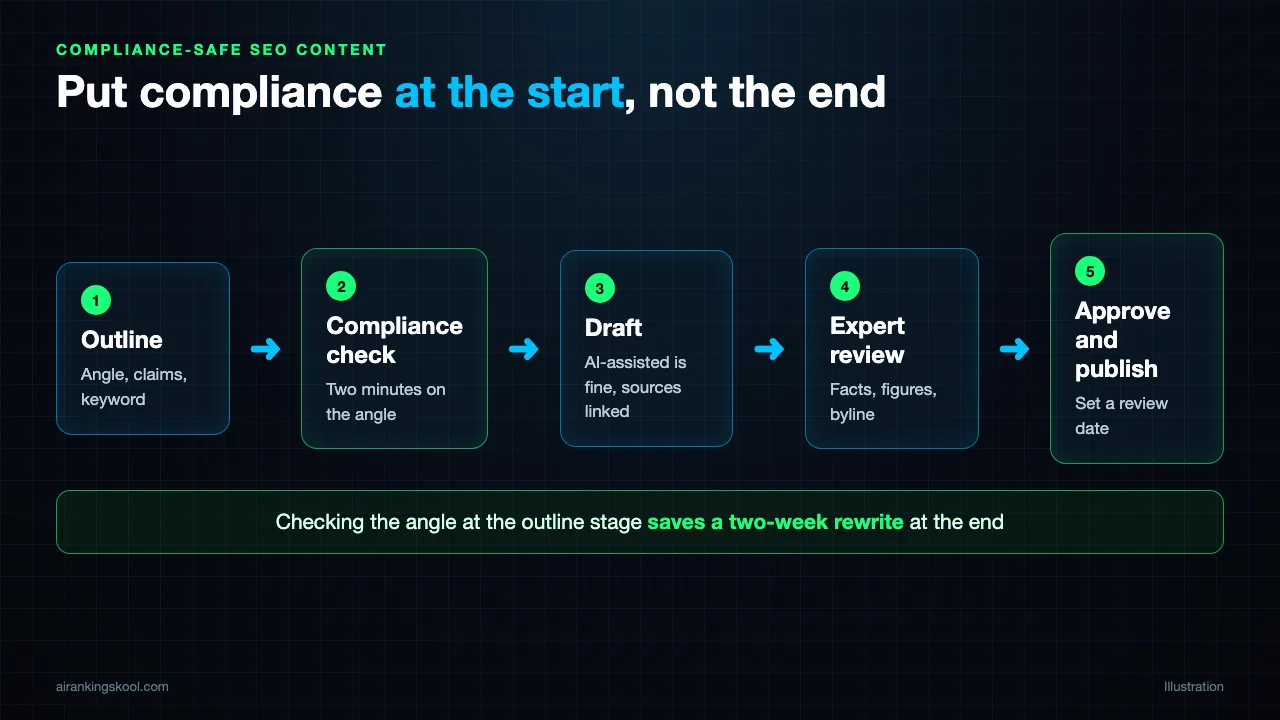
None of this is legal advice, and rules change. The point is practical: involve compliance at the outline stage. A two-minute check on the angle saves a two-week rewrite.
What is different about fintech SEO?
Fintech SEO blends YMYL trust requirements with SaaS-style tactics: product and feature pages, comparison pages, integration pages, developer docs and free tools. The product is software, but the buyer still wants proof it is safe.
Three things matter most for fintech companies:
- Crawlable product pages. Many fintech sites are built as heavy JavaScript apps. Make sure pricing, feature, security and compliance pages render as plain HTML that search engines and AI crawlers can read.
- Trust pages that answer the hard questions. Security, licensing, partner banks, insurance and data handling, each in plain language with the specifics a cautious buyer or a procurement team will check.
- Comparison and switching content. Buyers compare you to legacy banks and to other fintechs. Honest comparison pages, reviewed by compliance, capture that intent.
On a trading journal app I reviewed, the structured data didn't validate apart from the breadcrumb, so nothing told Google the site was software. My recommendation was SoftwareApplication, Product and FAQ schema, plus a section for each trading platform it connects to and each asset class it supports.
Our SaaS SEO guide goes deeper on the comparison, integration and review tactics that fintech companies borrow from software.
How do financial firms get cited in AI search?
Publish clear, sourced answers to the questions clients actually ask, make sure the same facts about your firm appear consistently across the web, and keep AI crawlers allowed. AI tools cite sources they can trust and verify, which is the same standard YMYL sets.
Google says there are no special optimizations required to appear in AI Overviews or AI Mode, beyond being indexed and eligible for a snippet. ChatGPT search relies on OAI-SearchBot, which OpenAI recommends allowing in robots.txt. Some security tools block unfamiliar bots by default, so check yours.
Then focus on answer quality. A page that opens with a direct, sourced answer to "how much does a fee-only financial advisor cost" or "what does an SBA loan require", written by a named expert, is the kind of passage AI tools quote. Our guides to getting cited in Google AI Overviews and ranking on ChatGPT walk through the format.
Be careful with volume. Google's spam policies cover scaled content abuse, including AI-generated pages that add little value. In finance, mass-produced pages carry a second risk: every one of them is a marketing communication that compliance should have reviewed.
What about financial advisors and wealth managers?
Independent advisors and wealth firms have their own playbook, mostly local and referral-driven, and we have covered it in depth:
- The complete guide to SEO for financial advisors, the full playbook for advisory firms.
- Local SEO for financial advisors, for ranking in the map pack in your area.
- An SEO audit for financial advisors, to find what is holding an advisory site back.
- SEO for wealth managers, for firms serving high-net-worth clients.
One pattern from my advisor reviews is going too broad. A divorce financial advisor I reviewed had strong, well-sourced content but targeted the whole country. Nationwide is tricky. I suggested picking three states, building service and location pages for those, and setting up Google Business Profiles that list the same services as the website.
For a real result, read how a solo financial advisor used AI to 7x his Google CTR. It is a member case study from inside the AI Ranking community.
How do you measure financial services SEO?
Track qualified consultations, applications and new accounts by landing page, plus how often your firm is named in AI answers for the questions clients ask. In finance, a handful of the right inquiries outweighs any traffic number.
- Conversion by page: which service, product and guide pages lead to booked calls or applications.
- Self-reported source: a "how did you find us?" field, because AI-assisted research often does not show up in analytics.
- AI answer checks: a monthly log of the same 20 client questions across ChatGPT, Perplexity and Google AI Mode.
- Search Console: impressions on question searches, where AI Overviews tend to appear.
One warning from experience: after a big restructure, expect traffic to dip for a month or two before it climbs. Check indexing in Search Console before deciding anything has failed.
When should a financial firm bring in an SEO consultant?
When you have marketing staff or an agency producing content but no strategy that balances growth, YMYL and compliance, or when competitors appear in AI answers and you do not. A consultant sets the plan and reviews the work. Your team implements, and your compliance team keeps the final say.
That is how our financial services SEO consulting works: advisory, for established firms and fintech companies with a site, some traffic and people to execute. It starts with where you show up in Google and AI answers today.
If you are a solo advisor or a freelancer learning finance SEO, the AI Ranking community covers the same playbook step by step.