AI SEO for Law Firms: How to Rank in Google, the Map Pack and ChatGPT
SEO for law firms now means the map pack, AI Overviews and ChatGPT shortlists. Here is what to build, and the bar rules to follow.

SEO for law firms now means ranking in three places at once: the Google map pack, the AI Overview above the results, and the shortlist ChatGPT gives when someone asks for a lawyer. The fundamentals of law firm SEO have not changed. Practice area pages, a complete Google Business Profile, real reviews and clean technical basics still decide who shows up. What has changed is that AI tools now read those same signals and compress them into a handful of names.
This guide is for managing partners and in-house marketers, and for the freelancers and agencies who run legal SEO for clients. It covers what to build, what AI search rewards, and the bar advertising rules that make legal SEO different from every other local niche.
What is law firm SEO in 2026?
Law firm SEO is the work of making a firm findable and trusted wherever prospective clients search for legal help: Google's organic results, the local map pack, and AI answers from tools like ChatGPT and Google AI Overviews. The goal is signed cases, not traffic.
The money in this niche explains why it is so competitive. In live DataForSEO data pulled for this post (US, November 2026), "law firm seo" and "seo for law firms" each get about 3,600 searches a month, and advertisers pay around $85 a click for them. "Seo for lawyers" adds another 720 searches at a similar price. Those clicks are expensive because each signed case is worth a lot to a firm.
The search results tell you the rest. When we checked the live SERP, Google opened with an AI Overview, then a run of agency pages, "best law firm SEO companies" lists and paid ads. The AI Overview listed the same core pillars every serious guide agrees on: practice area pages, local SEO, technical basics, helpful content, and authority. The difference in 2026 is where those pillars get judged.
How do potential clients find lawyers now?
They still search Google, but more of them now read an answer before they ever see a list of links. A search like "divorce lawyer near me" shows a map pack, while a question like "do I need a lawyer for a car accident claim" often triggers an AI Overview that names sources.
That gives you three surfaces to plan for:
- The map pack for "[practice area] lawyer near me" and "[practice area] lawyer [city]" searches.
- AI Overviews and AI Mode for question searches, where Google summarizes an answer and cites pages.
- AI assistants like ChatGPT and Perplexity, where someone types "who is a good employment lawyer in Denver" and gets three to five names.
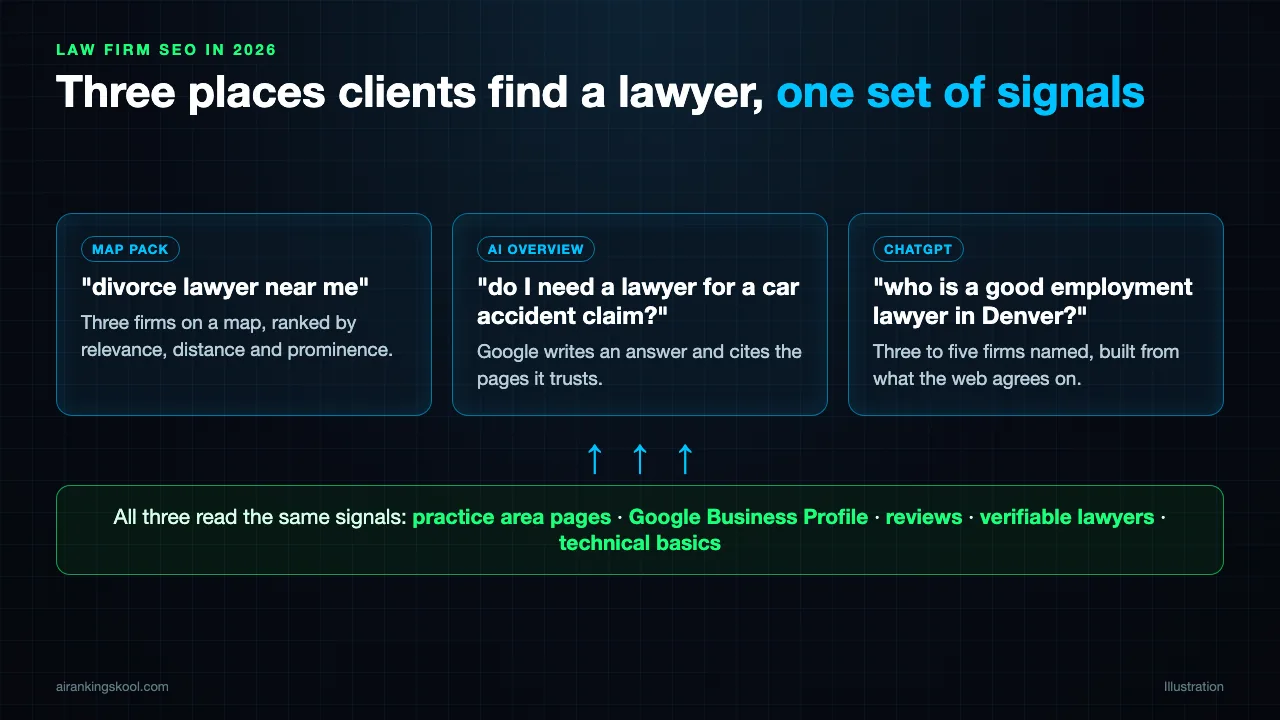
The good news: these surfaces mostly reward the same work. Google says there are no special optimizations needed to appear in AI Overviews or AI Mode. A page has to be indexed and eligible to show with a snippet, and the usual SEO basics apply. If you want the deeper version of how AI answers pick sources, our guide to generative engine optimization walks through it.
It's also why I now tell firms to put service pages ahead of blog posts. When I reviewed an IP firm in Melbourne, most of its effort had gone into explainer content about what a trademark is, which is exactly what AI Overviews now answer directly. The pages that turn a search into a client were the ones missing.
Which law firm SEO work matters most?
Build one strong page per practice area, make your Google Business Profile complete and accurate, earn steady reviews, and fix the technical basics. Everything else is a multiplier on those four.
1. One page per practice area
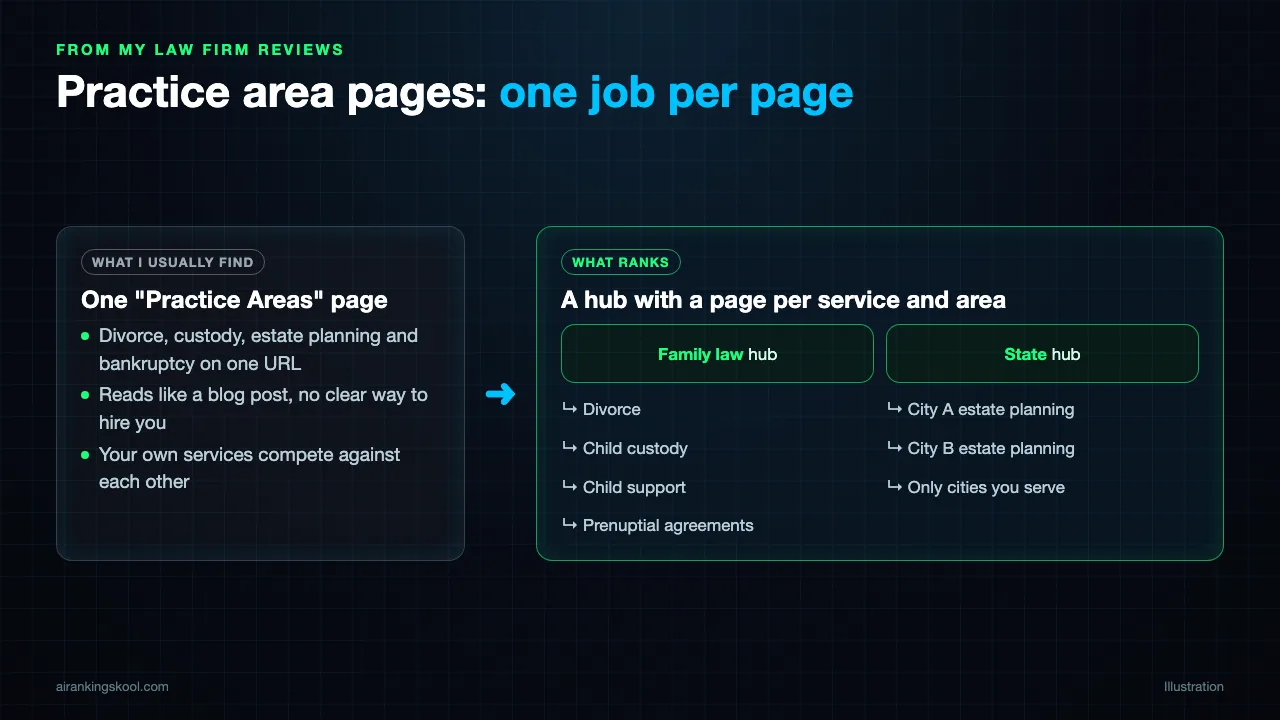
A single "Practice Areas" page listing personal injury, family law and estate planning cannot rank for all three. Each service people search for deserves its own page that answers the questions a client has before they call: what the process looks like, typical timelines, what to bring to a consultation, and what it costs to get started. Family law firms usually need separate pages for divorce, custody, child support and prenups, because people search for each one differently.
This is the problem I find most often. Of the nine law firm websites I've reviewed on my channel, eight had practice area pages that were missing, lumped onto one page, or written like blog posts. A London immigration firm's skilled worker visa page explained the visa in detail but never offered to help anyone apply. As I told them, it "reads more like a blog post instead of a transactional page." Another firm had every practice area on a single page, so its own services were competing against each other.
For firms covering several areas, I map a hub page for the bigger area with child pages beneath it. For a bankruptcy and estate planning firm, that meant one hub per state and a page for each city they actually serve. Depth matters too: an employment firm I reviewed had a discrimination and harassment page with almost nothing on it. The fix didn't need a redesign, just how the process works, the state law that applies, reviews and the attorney who handles those cases. I also tell firms to build their FAQ from the questions clients already ask on calls, even when no keyword tool shows them.
2. A complete Google Business Profile
Google says local results are based mainly on relevance, distance, and popularity, and that prominence draws on things like links to your business and how many reviews you have. Your profile is where relevance starts: the right primary category (for example, "Personal injury attorney" rather than just "Lawyer"), accurate hours, a real office address and services that match your website.
Keep the business name clean. Google's profile guidelines say your name should reflect your real-world name as used on your signage and website. Stuffing "Best Car Accident Lawyer Houston" into the name is a common shortcut, and it puts the whole profile at risk.
3. Reviews, earned the right way
Reviews feed both the map pack and the AI answers that summarize what clients say about a firm. Ask every satisfied client, make the link easy, and reply to reviews in a way that never confirms someone was a client or discusses their matter. Check your state bar's guidance on review requests and incentives before you build a process.
4. Technical basics
Fast mobile pages, clean URLs, one H1 per page, an XML sitemap and LegalService or Attorney schema are table stakes. Make sure AI crawlers can reach the site too. OpenAI says OAI-SearchBot is what surfaces websites in ChatGPT search, and it recommends allowing it in robots.txt. A technical SEO audit catches most of these issues in an afternoon.
How do you get ChatGPT to recommend your law firm?
Be consistently described the same way across your site, your profile, legal directories and the press, so AI tools can confidently match your firm to a practice area and a city. AI assistants recommend firms they can verify, not firms that simply claim to be the best.
When someone asks ChatGPT for a lawyer, it searches the web, reads several sources and builds a short answer. Your job is to make sure the sources it reads agree about you. That means:
- Clear practice area pages that say plainly who you help, where, and with what. "We represent injured workers in Cook County" beats a paragraph about passion for justice.
- Consistent listings on the legal directories and bar association pages that rank for your practice area searches. Same name, address, phone and practice areas everywhere.
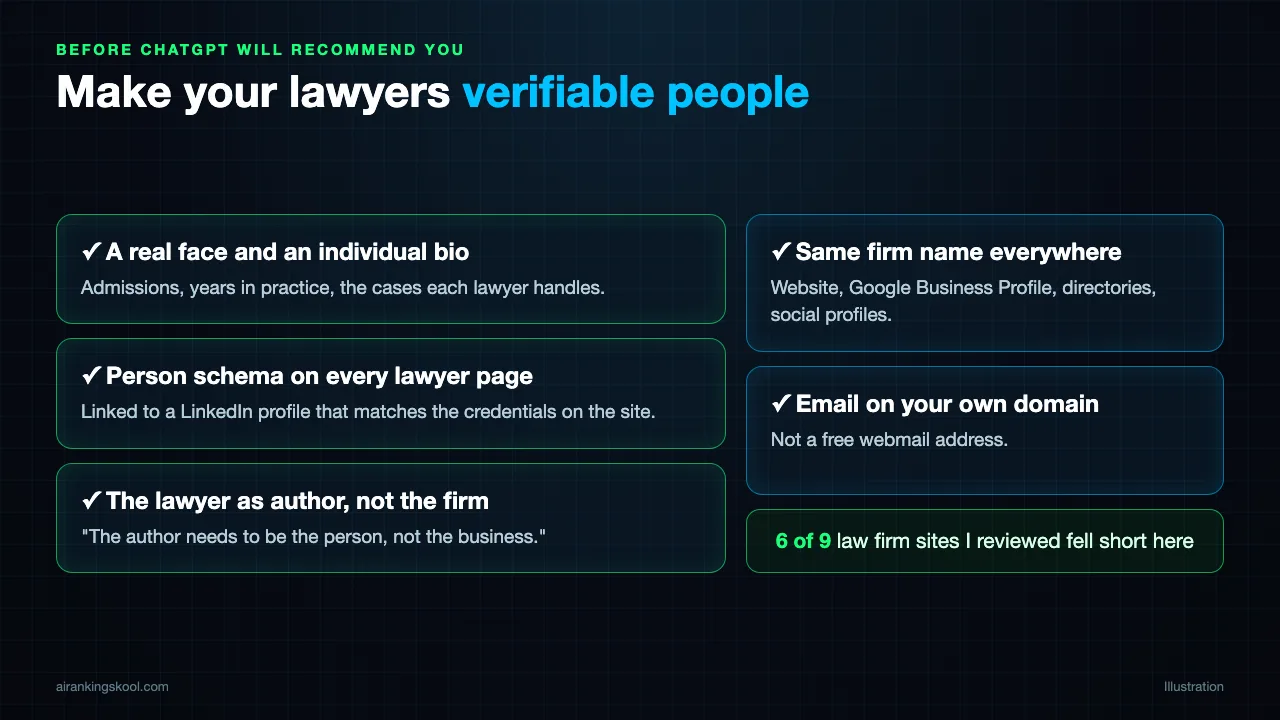
- Attorney bio pages with real credentials: admissions, years in practice, published articles, speaking and verdicts you are allowed to share.
- Answers to the follow-up questions. AI tools break a question into smaller searches. A page that answers "how long does a workers' comp claim take in Illinois" gets pulled into more of them.
That last point is called query fan-out, and it is why thin service pages lose. Our guide to ranking on ChatGPT covers the full process, and you can test where you stand by asking ChatGPT, Perplexity and Google's AI Mode the questions your clients ask.
The first thing I check on a law firm site is whether the lawyers exist as verifiable people. Six of the nine firms I reviewed fell short: no faces, no individual bios, no Person schema, no LinkedIn profile matching the credentials on the site. One firm credited its articles to the firm itself. As I put it in that review, "The author needs to be the person, not the business." Small things count as well, like using the exact same firm name on every profile and an email address on your own domain.
What do bar advertising rules mean for law firm SEO?
Your website, profile and AI-ready content all count as lawyer advertising, so the same rules apply: nothing false or misleading, no unearned specialist claims, and no paying people to recommend you. This is the part generic SEO playbooks miss.
Every state has its own version of the ABA Model Rules, so check yours. As one example, California's rules say a lawyer shall not make a false or misleading communication about the lawyer or the lawyer's services. The same chapter limits saying you are a "certified specialist" unless a recognized body has certified you, and it bars giving anything of value to someone for recommending your services, with listed exceptions such as paying for advertising.
Here is how that lands on the SEO work itself:
| SEO tactic | The compliance question | Safer approach |
|---|---|---|
| "Best divorce lawyer in Miami" title tags | Is "best" a claim you can back up? | Lead with the practice area and city, and let reviews do the bragging |
| "Specialist" or "expert" on service pages | Are you certified by a recognized body? | Use "focuses on" or "practices" unless you hold the certification |
| Case results pages | Could past results imply a promised outcome? | Add the disclaimers your state requires next to every result |
| Review requests | Are you offering anything in return? | Ask every client the same way, with no incentive |
| AI-written FAQ answers | Could a general answer read as legal advice? | Have an attorney review every page before it goes live |
| Paid directory listings | Is it advertising or a paid referral? | Check your state's rules on lawyer referral services |
None of this stops you from ranking. It means your content needs a lawyer's sign-off, and it means the claims that win in AI answers are the specific, checkable ones: years of practice, bar admissions, the counties you work in, published guides.
Sourcing is where I see firms slip most. In four of my law firm reviews, pages made legal or statistical claims with no source: a percentage with no study behind it, "legislation changing in 2026" with no countries named, immigration rule changes with no link to the government page. My question is always the same: where did you get that information? In a legal niche, a link to the statute, the court or the official source is non-negotiable.
Should a law firm use AI to write its content?
Use AI to research, outline and draft, then have an attorney rewrite and approve every page. Publishing AI-generated pages at volume without that review is how firms end up with thin, risky content that neither Google nor clients trust.
Google calls out scaled content abuse as a spam policy: generating many pages mainly to manipulate rankings, including with generative AI, without adding value. A firm that spins up 200 "[practice area] lawyer in [town]" pages with swapped city names is exposed to that policy. A firm that publishes ten genuinely useful guides on the questions its intake team hears every week is not.
Legal content also sits close to what Google calls Your Money or Your Life topics, the ones that can affect someone's health, finances or safety. Google says its systems give even more weight to strong E-E-A-T on those topics, and that trust matters most. Named attorney authors, reviewed dates and real credentials are not decoration here. They are the ranking signal.
AI is genuinely useful for the grunt work: pulling the questions people ask, building outlines from competitor pages, drafting a first pass of a FAQ, and checking your pages for missing schema or broken links. That is scale. The judgment, the specifics and the sign-off stay human.
How do you measure law firm SEO results?
Track signed cases and qualified consultations by source, not rankings or sessions alone. A page that brings in two good personal injury inquiries a month beats one that brings in 2,000 visitors who want free advice.
A simple measurement setup covers most firms:
- Call tracking on the website and the Google Business Profile, so you know which calls came from organic search and which came from the map pack.
- Form tags that capture the landing page, so you can see which practice area pages produce consultations.
- Search Console for the queries and pages that earn impressions, including the question searches where AI Overviews appear.
- A monthly AI check: ask the same ten client questions in ChatGPT, Perplexity and Google AI Mode, and log whether your firm is named or cited.
Before any of that, check the basics that leak leads. On one bankruptcy firm's site, the call button wasn't even clickable. On another, the only call to action sat at the bottom of a long page, where most visitors have already left. And if new pages aren't showing up at all, treat it as an indexing problem first: "crawled, currently not indexed" in Search Console usually means Google read the page and didn't think it was good enough yet.
For that last one, our walkthrough on tracking AI Overview citations shows a free way to check your own keywords.
When should a law firm bring in a law firm SEO consultant?
When you have an in-house marketer or agency doing the work but no clear strategy for AI search, or when results have stalled and nobody can explain why. A consultant's job is the plan and the review, not the execution.
Most firms do not need another agency retainer. They need someone to audit what exists, decide which practice areas and cities to go after first, and check the work against both search and bar rules. If that is where you are, see how our AI SEO consulting for law firms works: it is advisory, your team or agency implements, and it is built for firms that already have a site and some traffic.
If you are a solo practitioner or a freelancer building legal SEO skills, start smaller. The AI Ranking community teaches the same SEO and GEO playbook step by step, with templates you can apply to a firm site this week.