B2B SEO Strategy: How to Win Buyers in Google and AI Search
A B2B SEO strategy built for buying committees and AI search: the pages to build, a real example, and pipeline metrics.

A B2B SEO strategy is a plan to get your business found by the people who buy from you, at every stage of a long, committee-driven decision, in Google and in the AI tools those buyers now ask first. It is less about traffic and more about being the name that keeps coming up while a buying group does its research.
Search interest is moving in that direction. In live DataForSEO data for the US (November 2026), "b2b seo" gets about 260 searches a month and is up 129% year on year, "seo for b2b companies" gets 320, and "b2b seo strategy" gets 210 with a keyword difficulty of just 9. Advertisers pay $14 to $20 a click for them.
This guide is for B2B business owners and marketing leads, and for the freelancers and agencies who run SEO for B2B clients. It covers what makes B2B SEO different, the pages that matter, how AI search changes the game, and how to measure it in pipeline.
What makes B2B SEO different from B2C SEO?
B2B SEO targets a small number of high-value buyers who research for weeks or months, often as a group, so it chases specific low-volume keywords and measures success in pipeline rather than traffic. One right visitor can be worth more than ten thousand wrong ones.
| B2C SEO | B2B SEO | |
|---|---|---|
| Who searches | One person, often on impulse | Several people with different jobs on a buying committee |
| Keywords | High volume, broad | Low volume, specific, often technical |
| Sales cycle | Minutes to days | Weeks to months |
| Content that converts | Product pages, reviews, deals | Use cases, comparisons, pricing logic, proof, implementation detail |
| Success metric | Revenue per session | Qualified leads, opportunities and closed revenue |
| Where trust comes from | Ratings and brand | Case studies, named experts, reviews, industry mentions |
That last row matters more every year. A buying committee does not trust a vendor because it ranks first. It trusts a vendor because the vendor shows up, with the same clear story, across search results, AI answers, review sites and industry conversations.
How does AI search change a B2B SEO strategy?
Buyers now ask AI tools to explain the problem, list the options and build a shortlist before they visit any vendor site, so your strategy has to win the AI answer as well as the click. Being cited inside the answer is the new page one.
The clearest numbers come from software buying. In G2's 2026 AI search survey of B2B software buyers, 71% said they rely on AI chatbots somewhere in their research, and 85% said they think more highly of a vendor an AI cites in its answer. It is G2's own survey and it covers software buyers only, but the habit it describes, asking an AI tool before asking a vendor, is not unique to software.
The good news is that winning AI answers mostly rewards the same work as classic SEO. Google says there are no special optimizations required for AI Overviews or AI Mode beyond being indexed and eligible for a snippet. What AI search punishes is vagueness. If your site says you "empower teams to drive outcomes", no AI tool can match you to a buyer's question. If it says "we do restaurant accounting in New York City", it can.
I've been telling B2B owners this all year: you can no longer just say you help small businesses. An AI agent researching on a buyer's behalf already knows their industry, size and software. Your website isn't only a destination anymore. It's a data source those agents read, and vague positioning matches nothing.
What does a B2B SEO strategy look like in practice?
Define who buys and what they ask, build one strong page per service and use case, prove it with real cases and named experts, and earn mentions on the sites your buyers and AI tools read. Here is the order that works.
1. Map the buying committee's questions
List the people involved in a purchase (the user, the budget holder, the technical evaluator, the executive sponsor) and the questions each one asks. Your sales team already knows them. Turn every recurring question into a page or a section. The evaluator wants integration and security detail, while the budget holder wants pricing logic and payback.
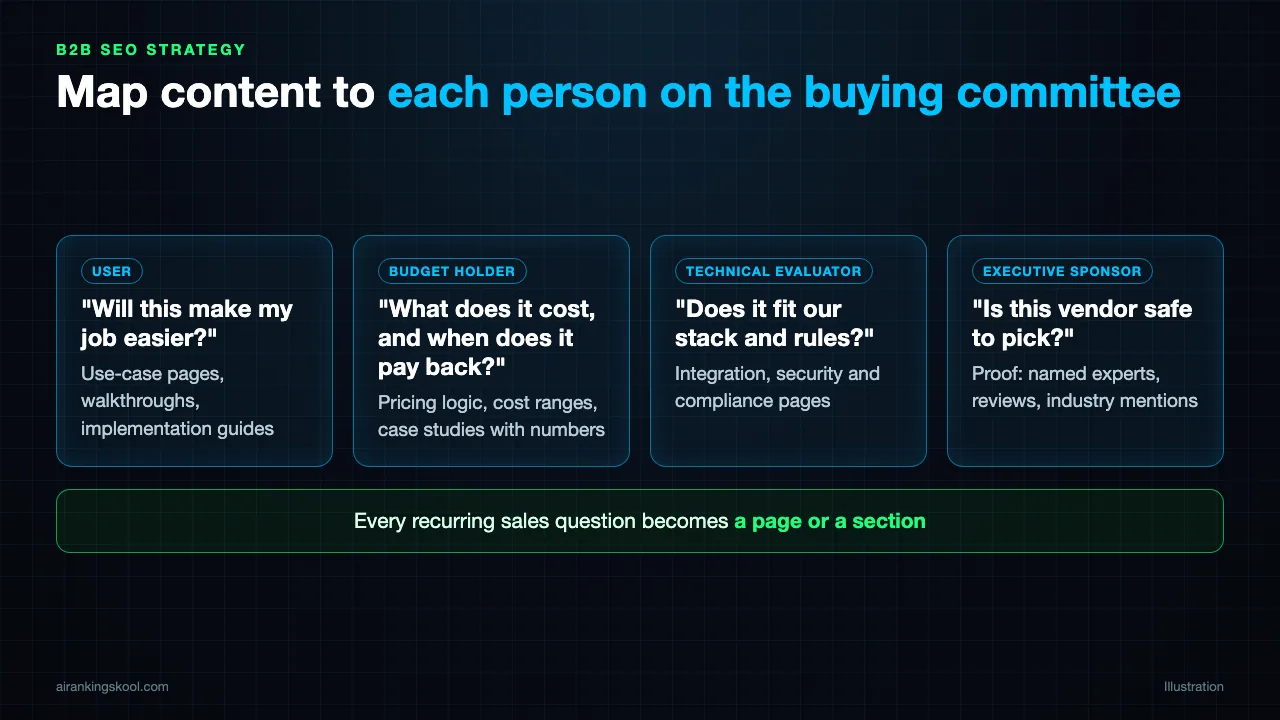
Don't let low search volume scare you off. A UK engineering consultancy I reviewed had sector pages targeting terms with almost no measurable volume, and I told them to keep building them. Just because a keyword tool shows zero doesn't mean nobody is looking, and the more niche you get, the easier it is to be the obvious answer.
2. Build pages for services, industries and use cases
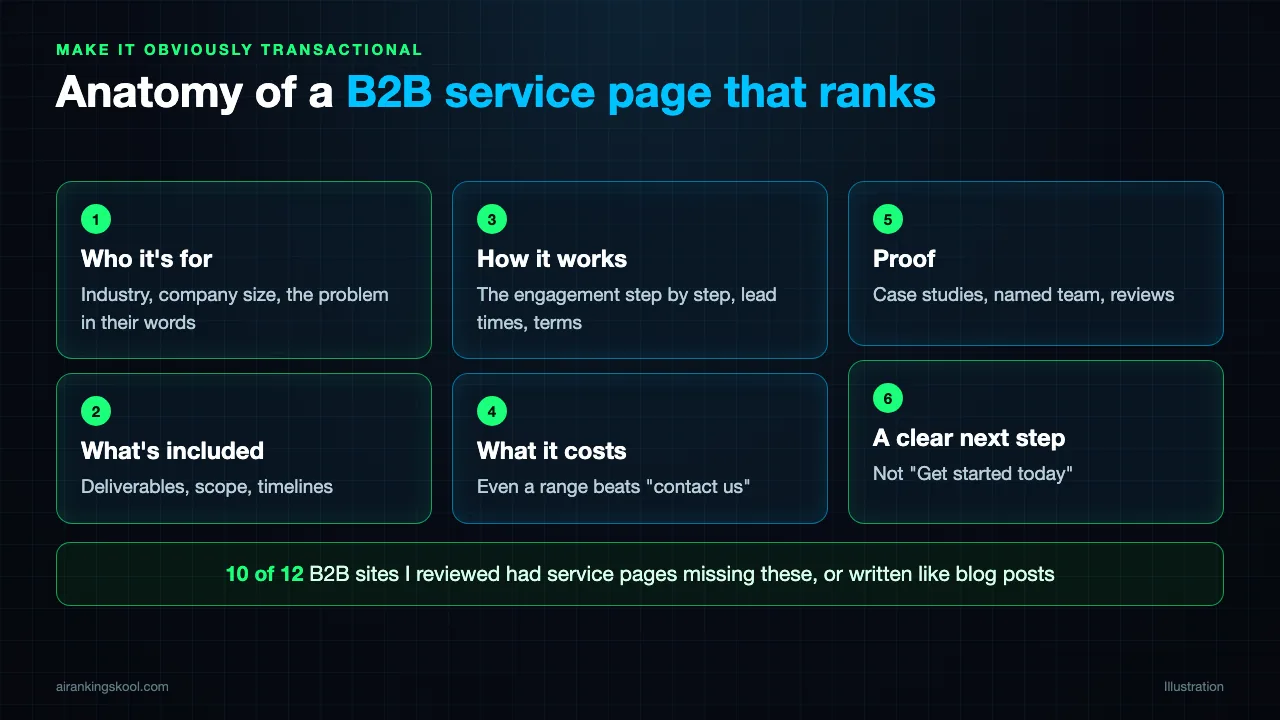
A single "Services" page cannot rank for six services. Build one page per service, and add industry or use-case pages where buyers search that way ("payroll outsourcing for construction companies"). Each page should state who it is for, what is included, how the engagement works and what it costs to get started, even as a range.
This is the most common problem I find. Across about a dozen B2B websites I've reviewed, ten had service pages that were missing, had no call to action, or read like blog posts. A process safety consultancy's service pages were written as articles, so for all intents and purposes Google treated them as blog posts. An Australian ERP implementation partner had one page that just said "Odoo", which is close to impossible to rank. The fix was a page for each industry they implement for. You don't need a programmatic build of 1,000 pages either: for one business operations consultancy, I suggested about five new industry pages.
3. Prove it
Case studies with real numbers, named team members with real credentials, client logos you have permission to use, and reviews on the platforms your industry uses. AI tools look for evidence that a claim is true, and so do buying committees.
Almost every B2B site I review hides the people. Nine of the twelve had no named team member, no Person schema and no link to the founder's LinkedIn, even when that LinkedIn profile was the strongest asset the business had. A marine fender manufacturer I reviewed had no social profiles at all. Add them to your Organization schema, even if you think your industry doesn't use social media. It's the cheapest trust you can add.
4. Earn mentions where buyers look
Industry publications, association directories, podcasts, partner pages, review platforms and the community threads where people ask for recommendations. Each one is another source that describes you the same way. This is what turns a site that ranks into a brand that gets recommended.
5. Fix the technical basics
Fast pages, clean URLs, schema for your organization and services, and access for AI crawlers. OpenAI recommends allowing OAI-SearchBot, the crawler behind ChatGPT search. A technical SEO audit catches the usual blockers.
6. Connect the pages
Link every educational guide to the service or use-case page it supports, and link service pages to the case studies that prove them. Internal links tell search engines which pages matter most, and they move a buyer from a question to a decision without a dead end. A simple hub for each service, with its supporting guides and cases underneath, is enough for most B2B sites.
What does this look like for a real B2B firm?
A useful example from inside our community is a two-person New York City accounting firm that serves restaurants. We broke it down in this AI Overviews case study. The member rebuilt a thin landing page into a full site with a page for each service and the specific problems restaurant owners face, like the Commercial Rent Tax, tip credits and payroll across the five boroughs.
I reviewed that site twice. The first time, in March 2026, it was a single landing page with a "Get started today" button, no service pages, no schema, and a blog post that was one sentence long, quoting an "up to 80%" restaurant turnover figure with no source. By the second review in July, the headline said "restaurant accounting" in plain words instead of "financial operations", each service had its own page, and there were pages for different restaurant types and locations. Moving the services off the homepage into their own pages made a big difference. As I said in that review, it's not magic, it's just doing the fundamentals really well.
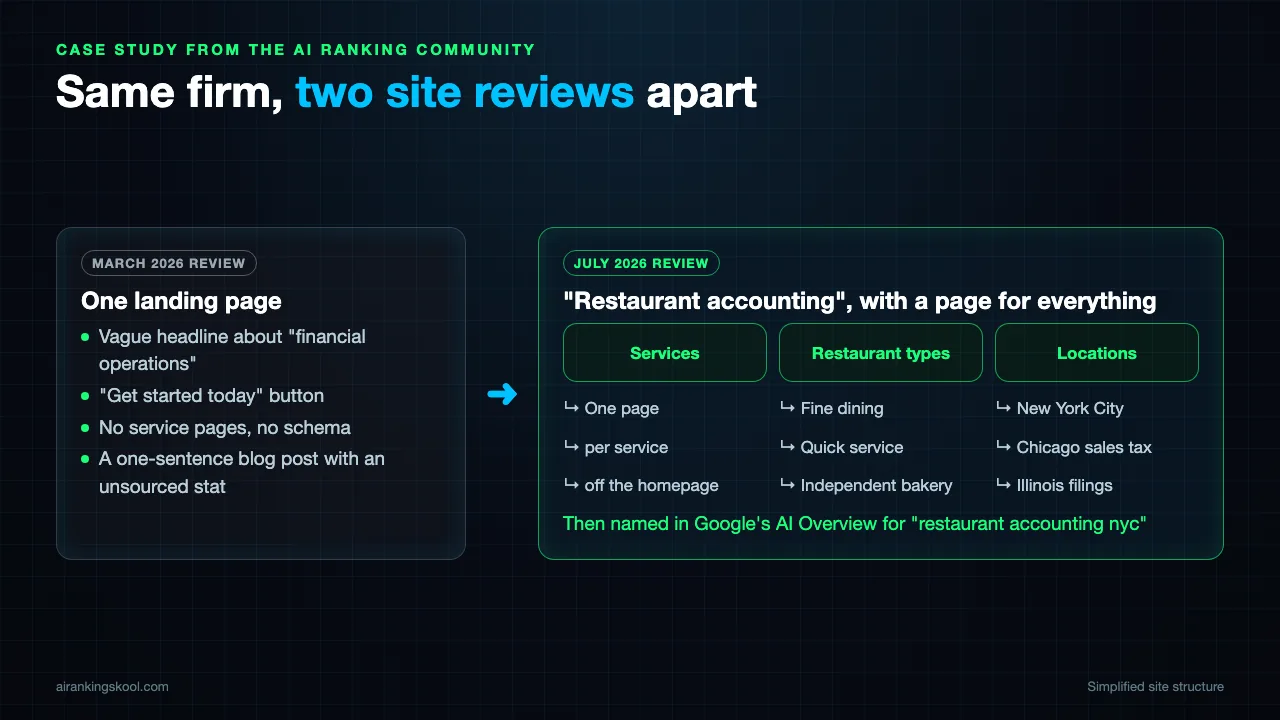
Weeks later, Google's AI Overview for "restaurant accounting nyc" listed the firm first among notable local firms, and quoted its own description of those NYC-specific services. The screenshots are member-provided, AI results vary by location and session, and the case study is clear that it does not claim a traffic number yet. What it shows is the pattern: specific pages for a specific buyer gave the AI something concrete to cite.
That is the whole B2B lesson in one example. The firm did not win by publishing more. It won by being specific about who it serves and what it solves.
What content should B2B companies publish?
Publish the content that helps a buyer make a decision: comparisons, pricing logic, implementation guides, case studies and honest answers to sales objections. Broad top-of-funnel definitions are increasingly answered by AI Overviews, so they earn fewer clicks than they used to.
- Decision content: "[your service] vs [alternative approach]", "how much does [service] cost", "how to choose a [provider type]".
- Proof content: case studies, before-and-after breakdowns, client results you are allowed to share.
- Objection content: the five questions that stall deals, answered in public.
- Expert content: original data, opinions and frameworks from named people on your team.
Match the depth to the deal size. An oil field invoice factoring firm I reviewed had sector pages a few paragraphs long, for contracts worth five figures. Make it stupidly obvious the page is there to win work: who it's for, what's included, the process, the terms and the proof. And a single landing page with a calculator and a booking link, like one cold email agency I reviewed, can work for paid traffic, but it has almost no chance of ranking on its own.
Write each page so the answer comes first and the detail follows. That structure is what AI tools quote. Our generative engine optimization guide explains why, and the query fan-out guide shows how one buyer prompt turns into several hidden searches your pages need to answer.
Use AI for research and first drafts, not for volume. Google's spam policies cover scaled content abuse, including pages generated with AI that add little value. A B2B site with 30 sharp pages will beat one with 300 generic ones.
How do you measure B2B SEO?
Measure qualified leads, opportunities and revenue by landing page and source, plus how often your brand is named in AI answers for your category. Traffic and rankings are inputs, not results.
- CRM attribution: capture the first landing page and source on every form and booked call, and carry it into the opportunity.
- Self-reported attribution: add "How did you hear about us?" to forms. Buyers who found you through ChatGPT often say so, even when analytics cannot see it.
- AI referrals: sessions from chatgpt.com, perplexity.ai and similar referrers.
- AI answer share: a monthly log of 20 category prompts across the main AI tools, recording whether you are named or cited.
For the Google side, our guide to AI Overview tracking covers a free way to see which of your keywords show an AI Overview and whether you are in it.
When should a B2B company hire a B2B SEO consultant?
When you have people producing content but no strategy tying it to pipeline, or when competitors keep appearing in AI answers and you do not. A consultant sets the plan and reviews the work. Your team or agency executes it.
Our B2B SEO consulting is built that way: advisory only, for established B2B firms with a site, some traffic and someone to implement. It starts with an audit of where you show up in Google and AI answers today, then a roadmap your team can run.
If you are a freelancer or a smaller firm learning to do this yourself, the AI Ranking community teaches the same B2B and GEO playbook with templates and weekly support.