How to Rank in AI Overviews: How a NYC Restaurant Accounting Firm Got Recommended by Google and ChatGPT
An AI Ranking member rebuilt his Claude-made landing page into a 98-URL Astro site. Weeks later, Google's AI Overview names his firm first for 'restaurant accounting nyc'. The full breakdown, with the 5-step playbook.

What happened: a two-person NYC firm showing up inside Google's AI Overviews
Type "restaurant accounting nyc" into Google and the AI Overview now opens its list of notable local firms with FORCS: "Provides industry-specific accounting and bookkeeping. They handle complex NYC regulations like the Commercial Rent Tax, tip credits, and payroll tracking across all five boroughs." Four months ago, this firm was effectively invisible for that search.
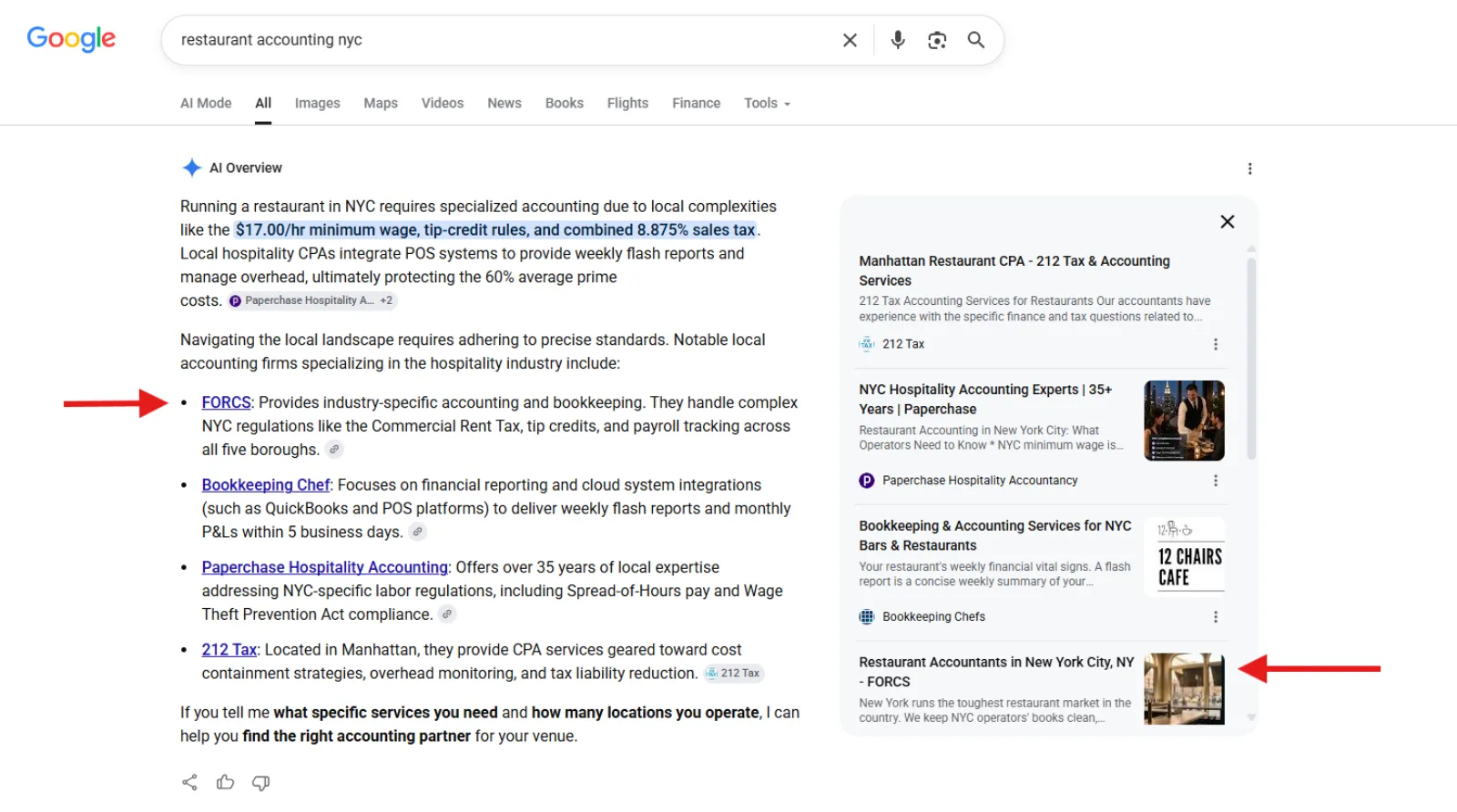
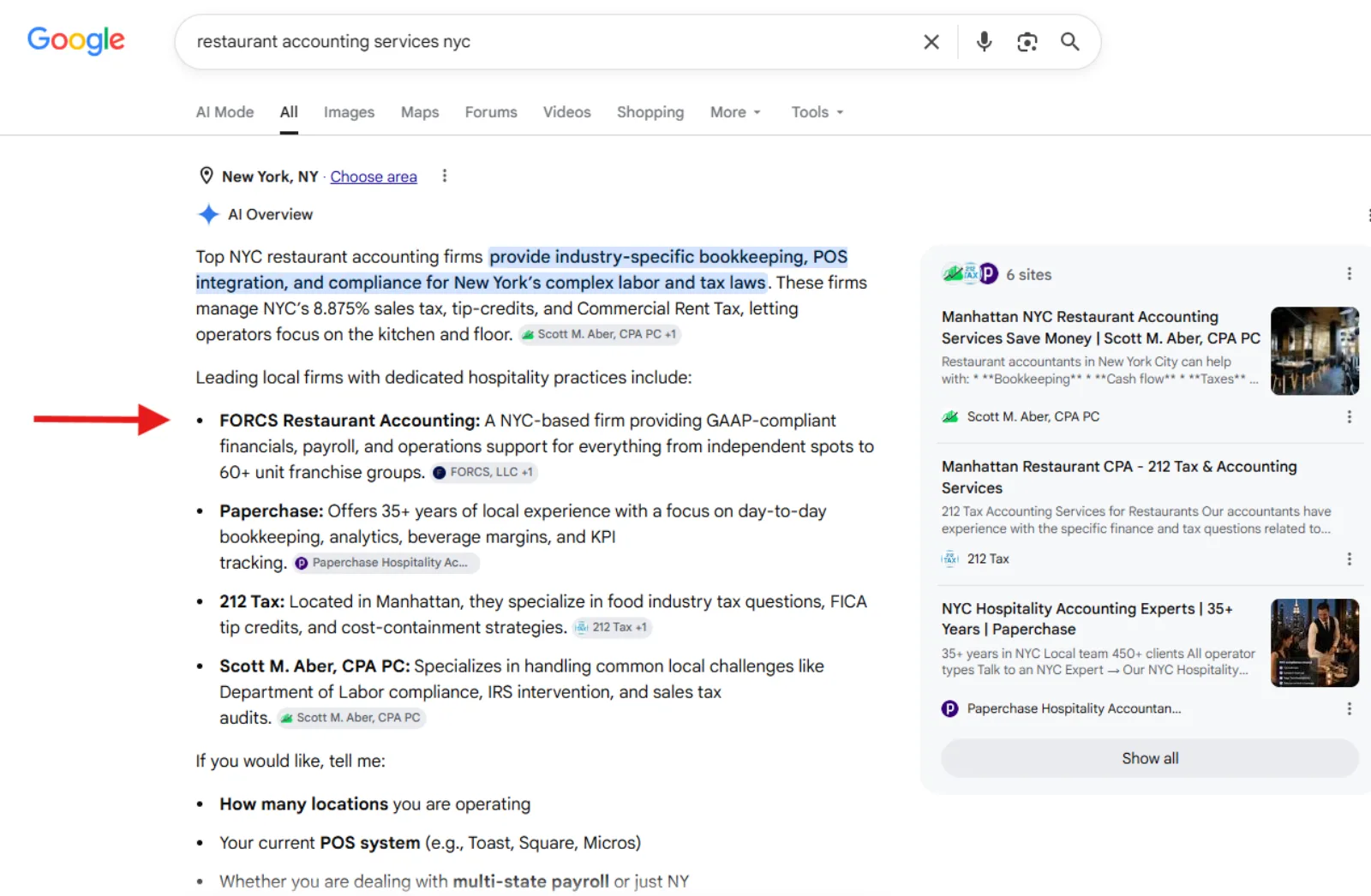
This is a member win from inside the AI Ranking community, and I want to break down exactly how it happened, because none of it is luck. The member rebuilt his site in a weekend with Claude, using the SEO checklist and site framework prompts from our classroom, and the AI engines responded within weeks. In his words:
"It was amazing to watch it go through and optimize everything. The design is so much better, the improvements Nico suggested were implemented, and I finally feel like I have something I can be proud of. Better yet, I am actually starting to see some results for a few keywords on Google and ChatGPT."
One honesty note before we start: the screenshots are member-provided, and AI Overview results vary by location and session. I am not going to claim a traffic number the Search Console data doesn't back yet. What I can show you is the exact structural work that preceded the citations, and why it maps one-to-one to how these engines choose sources.
Why do AI Overviews matter for a local service business?
AI Overviews appeared on roughly one in five Google searches as of March 2025, and when one appears, clicks on traditional results nearly halve. Pew Research found users clicked a standard result on just 8% of searches with an AI summary, versus 15% without one.
For a service business, that stat cuts both ways. If you are one of the ten blue links, the AI Overview is eating your clicks. But if you are the business named inside the answer, you just became the default recommendation before anyone scrolls. The classic funnel (rank, earn the click, convert on site) is being replaced by: get named, get brand-searched, get called. That is why being citable now matters as much as ranking, a shift we cover across our Claude SEO material.
Where it started: an AI-built landing page that couldn't rank
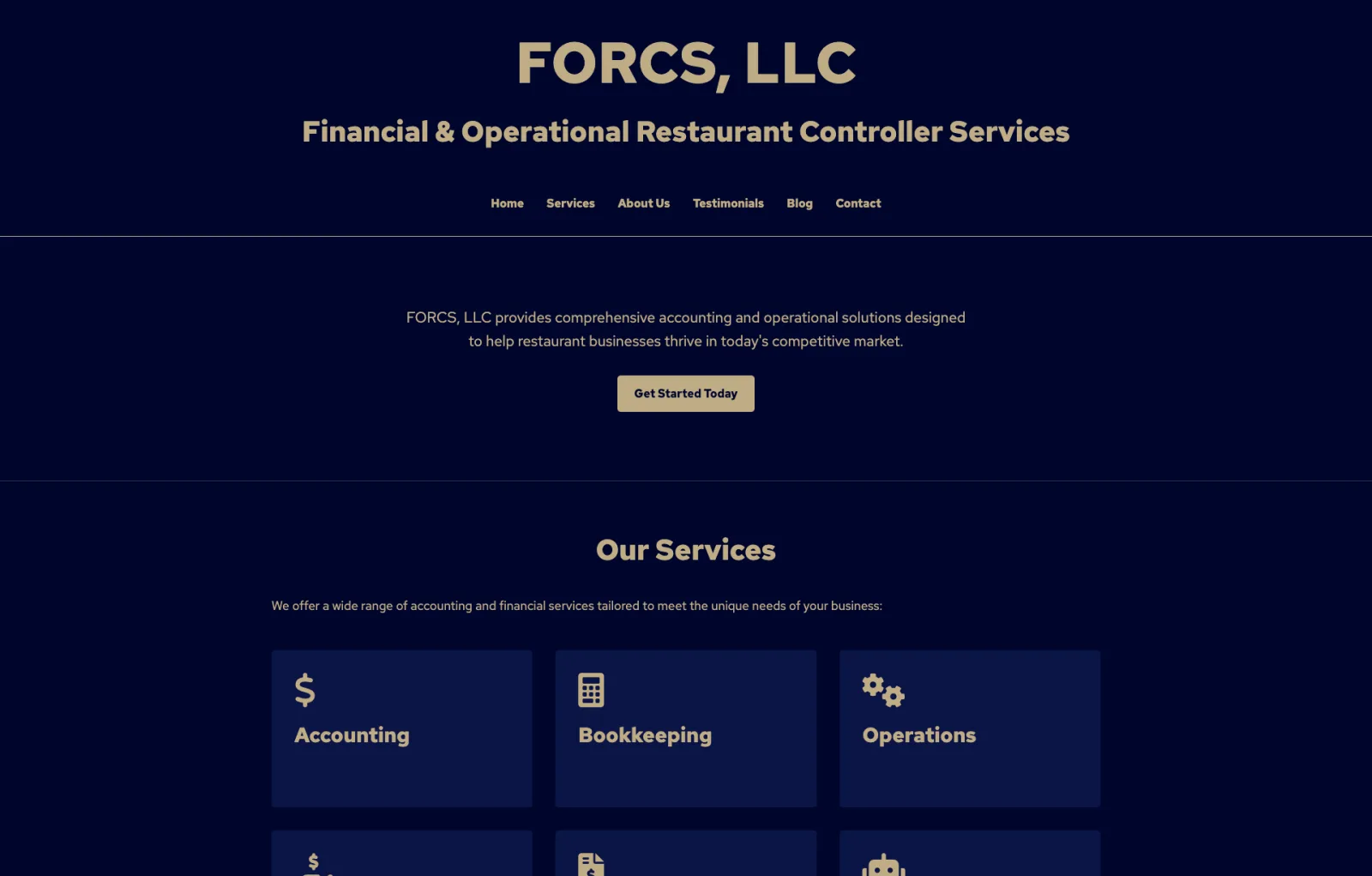
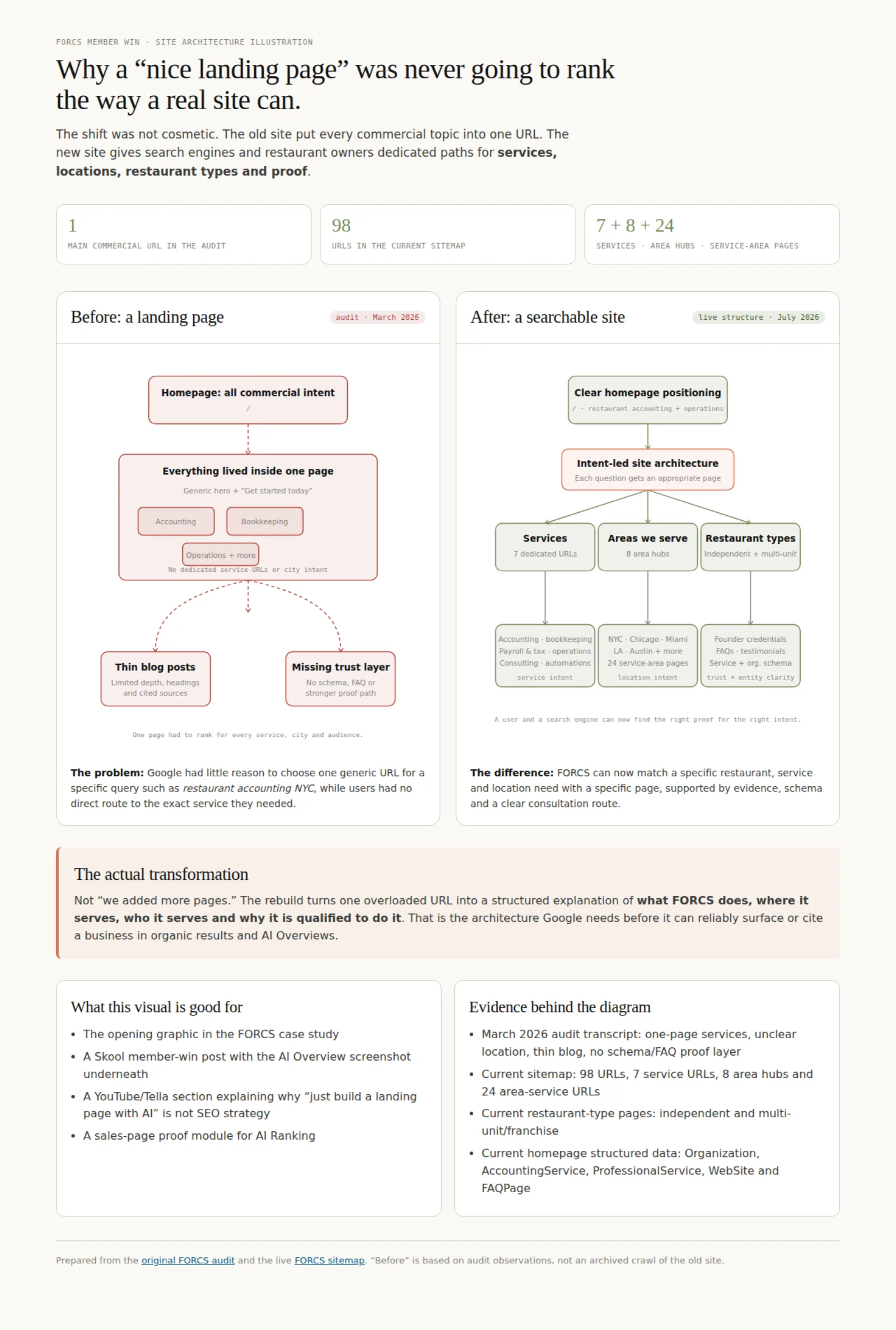
Eighteen months ago the member was starting his business and needed a website fast, so he told Claude to make him one. It worked as a business card and a lead form, but everything lived on a single page. When he submitted it for one of my weekly member site reviews back in March, the audit found three structural problems:
- Every commercial intent competed inside one URL. Accounting, bookkeeping, payroll, operations: all of it sat on the homepage with a generic hero and a "Get Started Today" button. Google had no dedicated page to rank for "restaurant accounting nyc", so it ranked nothing. This is the single most common mistake I see, and I've written about why one page can't rank for every service before.
- The blog was thin. Short posts, no real headings, no cited sources, nothing an engine would ever quote.
- The trust layer was missing. No schema, no FAQ, no proof pages, no path for a machine (or a skeptical restaurant owner) to verify who this firm was.
The rebuild: what he actually gave Claude
When Anthropic released the Fable model, the member decided it was time and handed Claude four inputs: the SEO checklist from the classroom, the new site framework prompts, the design of his old site, and the analysis of its issues from the March audit. Claude built an Astro site, deployed it to Cloudflare, and walked him through transferring DNS and settings from the previous host so nothing broke.
The output is not "a prettier landing page". It is a different information architecture. The old site put every commercial topic into one URL; the new site gives search engines and restaurant owners dedicated paths for services, locations, restaurant types and proof:
- 7 dedicated service pages (accounting, bookkeeping, payroll and tax, operations, consulting, automations and more)
- 8 "Areas we serve" hubs (NYC, Chicago, Miami, LA, Austin and more) feeding 24 service-area pages
- 2 restaurant-type pages (independent and multi-unit/franchise operators)
- A real trust layer: founder credentials, testimonials, FAQs, and Organization, AccountingService, ProfessionalService, WebSite and FAQPage structured data on the homepage
How to rank in AI Overviews: the 5 things that made this work
To rank in AI Overviews, a page must be indexed and snippet-eligible, and it wins the citation by answering one specific intent with a sentence an AI can lift verbatim. Google's own documentation says there are no additional requirements to appear in AI Overviews beyond core SEO, and the FORCS rebuild is a live demonstration of what executing those fundamentals actually looks like.
1. Clear the eligibility bar
Google states that to be shown in AI Overviews a page must be indexed and eligible to appear in Search with a snippet. The old single-page site gave Google one indexable URL; the new build ships 98 clean, fast, crawlable URLs on Cloudflare. You cannot be cited if you cannot be retrieved.
2. Give every intent its own URL
Google confirms AI Overviews may use a "query fan-out" technique, issuing multiple related searches across subtopics to assemble an answer. I've broken down how fan-out queries decide who gets cited: the engine effectively asks "restaurant payroll NYC", "tip credit compliance", "multi-unit restaurant bookkeeping" as separate questions. A one-pager can answer at most one of them. FORCS now has a dedicated page for each, which is exactly what building your site structure right from the start means.
3. Write an extractable entity capsule
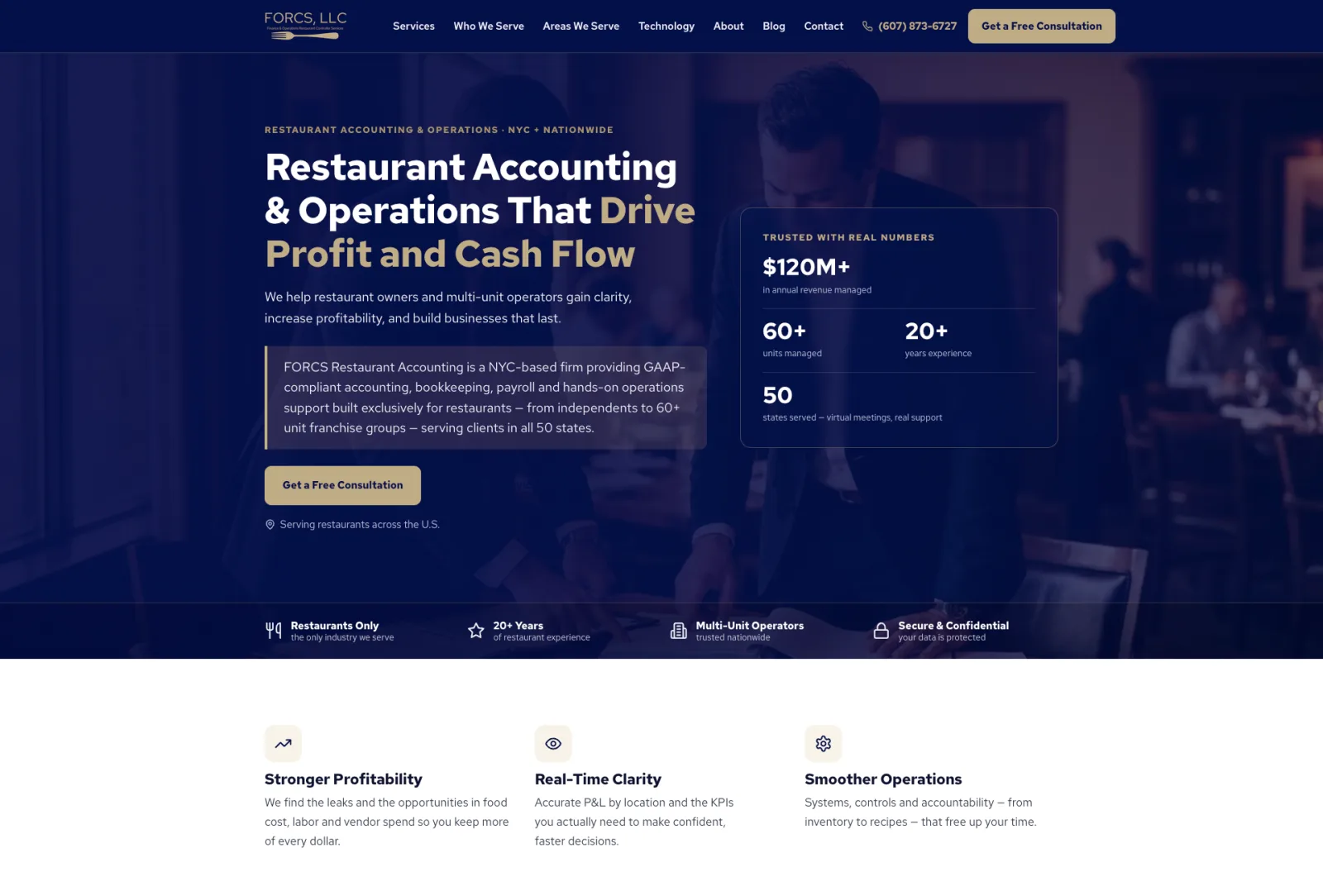
Here is the part I love. The new FORCS homepage carries one tight positioning paragraph: "FORCS Restaurant Accounting is a NYC-based firm providing GAAP-compliant accounting, bookkeeping, payroll and hands-on operations support built exclusively for restaurants, from independents to 60+ unit franchise groups." Now reread the AI Overview: "A NYC-based firm providing GAAP-compliant financials, payroll, and operations support for everything from independent spots to 60+ unit franchise groups."
Google's AI did not summarize the site. It essentially quoted the capsule back. Write the two-sentence answer you want the machine to say about you, put it high on the page, and make every claim in it concrete.
4. Build the trust layer
To be fair to Google, its guidance is explicit that no special schema, llms.txt file or AI markup is required. But structured data and proof pages are not about unlocking a feature, they are about making you a safe thing to recommend. An engine naming an accounting firm wants entity clarity (who is this, where, credentials) and verifiable specifics ($120M+ managed, 60+ units, 20+ years). FORCS now provides both in machine-readable and human-readable form.
5. Say something only you can say
The same Google guide tells creators not to recycle "what others on the internet have already said, or could easily be produced by a generative AI model". Look at what got quoted: the Commercial Rent Tax, the 8.875% NYC sales tax, tip credits, Spread-of-Hours pay. The AI Overview is assembled almost entirely from NYC-specific operational detail that generic accounting sites never mention. Niche specifics are citation bait.
What about ChatGPT? How do you get it to recommend your business?
The same structure that earns AI Overview mentions earns ChatGPT recommendations, because ChatGPT's search also decomposes a request into fan-out queries and cites the pages that answer one question cleanly. The member reports FORCS is now starting to appear for keywords in ChatGPT as well as Google.
There are ChatGPT-specific levers on top (I cover nine of them in how to rank in ChatGPT), but the sequence matters: intent-led structure and extractable capsules first, engine-specific tuning second. If your site cannot be quoted, no amount of tuning will get it recommended.
Steal this playbook
Everything the member used is sitting in the AI Ranking classroom: the SEO checklist, the site framework prompts, and the weekly site reviews where this journey started. I also recorded a full video walking through this case, embedded below. If you want your site reviewed the way FORCS was, that happens inside the community every week.
Frequently asked questions
How do I get my business to show up in Google AI Overviews?
Make sure every page is indexed and snippet-eligible, then give each service, location and audience its own page with a direct two-sentence answer at the top. Google confirms there are no special AI requirements: AI Overviews pull from the same index as normal Search, so structure and specificity decide who gets named.
How do you get ChatGPT to recommend your business?
ChatGPT recommends businesses whose pages cleanly answer the specific sub-questions it generates while researching, so cover each service and location on a dedicated page with concrete, verifiable claims. Consistent entity information across your site, schema and directories makes you a safer recommendation.
Do you need special schema or an llms.txt file to rank in AI Overviews?
No. Google explicitly says no llms.txt, AI-specific markup or special structured data is required to appear in AI Overviews. But structured data is still a piece of agentic SEO that Google itself recommends: its guidance on performing well in AI experiences says structured data shares your content "in a machine-readable way that our systems consider", which is exactly what makes it easier for AI systems and search agents to understand and cite you. Not an entry requirement, but a real advantage.
How long does it take to show up in AI Overviews?
In this case study, member-provided screenshots showed AI Overview mentions within weeks of the rebuilt site going live. Expect timing to vary with crawl frequency, competition and how established your entity already is; weeks to a few months is a realistic range for a niche local query.