Hermes SEO
Put the open-source Hermes agent to work on your SEO around the clock: a live dashboard, five recurring workflows, and approval gates that keep every change under your control. For owners, freelancers and agencies who want an SEO employee, not another chatbot.
What is Hermes Agent?
Hermes Agent is an open-source autonomous AI agent from Nous Research, released under the MIT license, that runs continuously on your own machine or a cheap VPS and gets more capable the longer it runs. Unlike a chatbot, it keeps working between your messages: it learns skills from experience, spawns subagents for parallel work, and reports back over Telegram and 20+ other messaging platforms.
It is the breakout agent of 2026. Searches for "hermes agent" grew from almost nothing in January 2026 to roughly 201,000 per month by April, per DataForSEO. It picked up the wave OpenClaw started and added the piece that matters for real work: a learning loop that turns what the agent did yesterday into a reusable skill today.
This page is the hub for using it on SEO specifically. It covers what Hermes SEO means, why an always-on agent beats chat-based SEO for recurring work, the SEO OS system we run it with (including the dashboard we open-sourced), and where a human must stay in the loop.
What is Hermes SEO?
Hermes SEO is the practice of running your SEO with the Hermes agent as a permanent worker: it watches your Google Search Console data, scores opportunities, runs CTR tests, drafts content, manages reviews and builds reports on a schedule, while you approve or reject every change before it ships. It is the current best implementation of agentic SEO: SEO executed by an autonomous agent under human supervision.
The distinction from AI-assisted SEO is who initiates the work. With AI SEO in a chat window, you prompt, it answers, and the work stops when you close the tab. With an agent, the work is scheduled: the agent wakes up, checks the data, does the task, and pings you on Telegram with the result. You go from doing SEO with AI to reviewing SEO an AI already did.
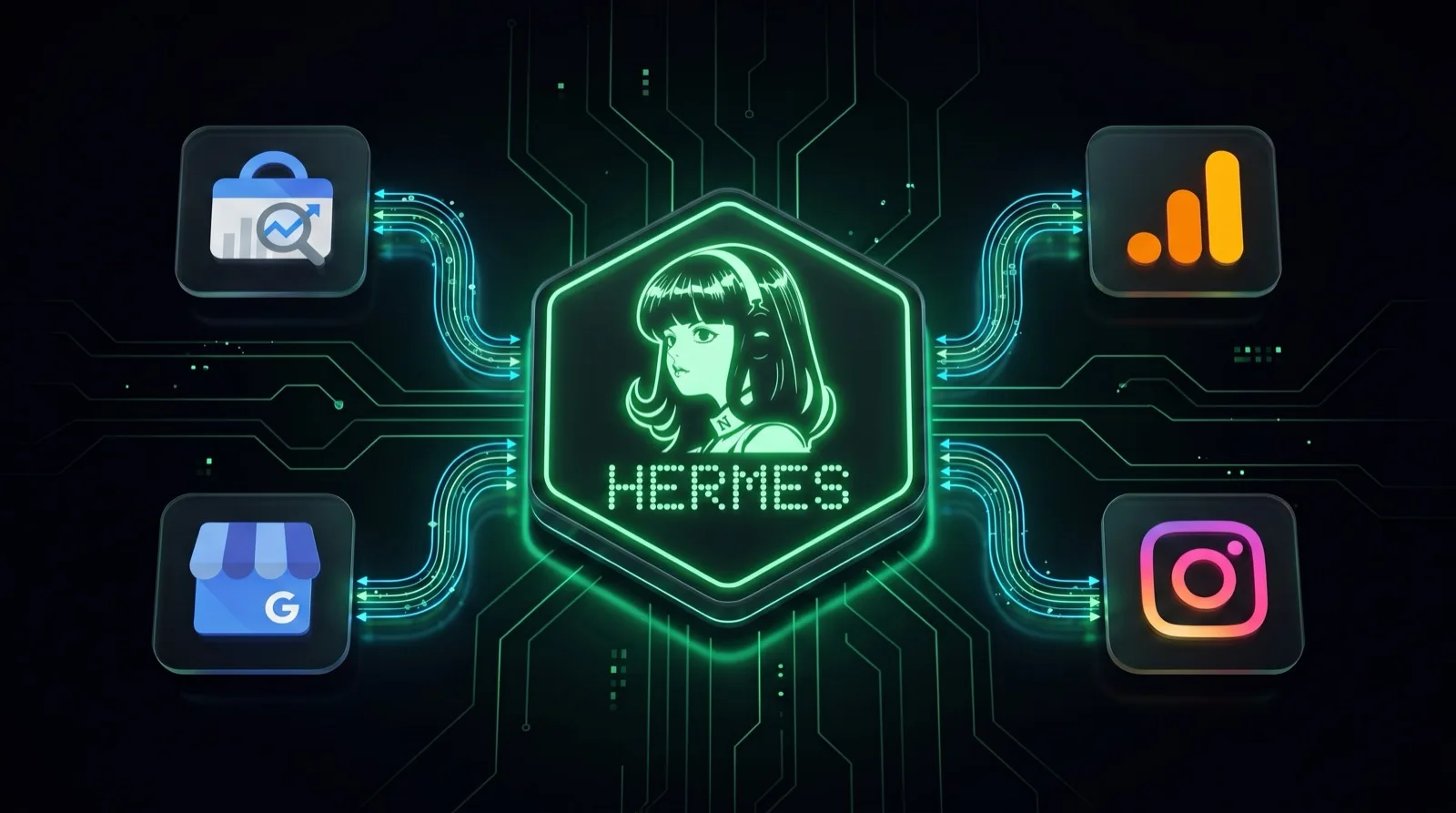
Why an always-on agent beats chat-based SEO
Chat-based SEO is limited by your attention: nothing happens unless you are typing. An always-on agent removes that ceiling, because recurring SEO work (rank checks, opportunity scoring, report building, content refreshes) happens on a schedule whether you are at the desk or not.
We run both, and they are one story. Claude SEO is our interactive workstation: deep audits, building pages, strategy sessions where we steer every step. Hermes is the always-on employee that handles the recurring 80% between those sessions. If you already automate with SEO automation scripts, an agent is the next step up: it handles the judgment calls scripts cannot, and escalates the ones it should not make alone.
The SEO OS mental model
SEO OS is our name for the operating system around the agent: a dashboard as the operating board, Hermes as the worker, Telegram as the notification layer, and approval gates as the safety layer. The agent does the work; the system makes the work visible, reviewable and safe.
| Layer | What it is | What it does |
|---|---|---|
| SEO OS dashboard | A Cloudflare-deployed operating board | Shows opportunities, agent tasks, CTR tests, schedules and reports per client |
| Hermes agent | The worker on your VPS | Executes the scheduled SEO workflows and proposes changes |
| Telegram | The notification layer | Onboards new clients, confirms setups, pings you when something needs a decision |
| Approval gates | The safety layer | Nothing ships to a live site until a human approves it |
| Hermes profiles | Client separation | Each client gets its own profile, workspace and knowledge library |
This structure is the difference between a demo and an operation. Most of what ranks for Hermes SEO today shows a one-off run on a test site. An operation needs state (what did the agent do last week?), separation (whose site is this?), and gates (who said this could go live?). That is what the OS layer adds.
What does Hermes actually do all day? The five workflows
In our SEO OS, Hermes runs five recurring workflows: opportunity scoring, CTR testing, the content pipeline, review management, and reporting. Together they cover the recurring work an SEO retainer is made of.
- Opportunity scoring. The agent reads Search Console data on a schedule and scores pages sitting just off page one, queries with impressions but no clicks, and decaying content worth refreshing.
- CTR tests. It proposes title and meta rewrites for high-impression pages, tracks the before and after, and logs results on the dashboard.
- Content pipeline. It drafts briefs and content from your keyword data and client knowledge library, then queues drafts for human review, never straight to publish.
- Review management. For local clients it monitors new reviews and drafts on-brand replies, holding the sensitive ones for approval.
- Reports. It assembles the weekly and monthly numbers into clean client-facing reports, the task most agencies still burn hours on.
Every workflow ends in the same place: a proposal on the dashboard waiting for a yes or a no. If a client is local, the review and report workflows plug into the same local SEO fundamentals we teach separately.
Does Hermes Agent have a dashboard?
Not out of the box: Hermes Agent officially ships with a CLI, a desktop app and messaging integrations, but no dedicated web dashboard. That is exactly why we built one. SEO OS is our open-source dashboard for running SEO with Hermes, and it deploys to your own Cloudflare account with one click.
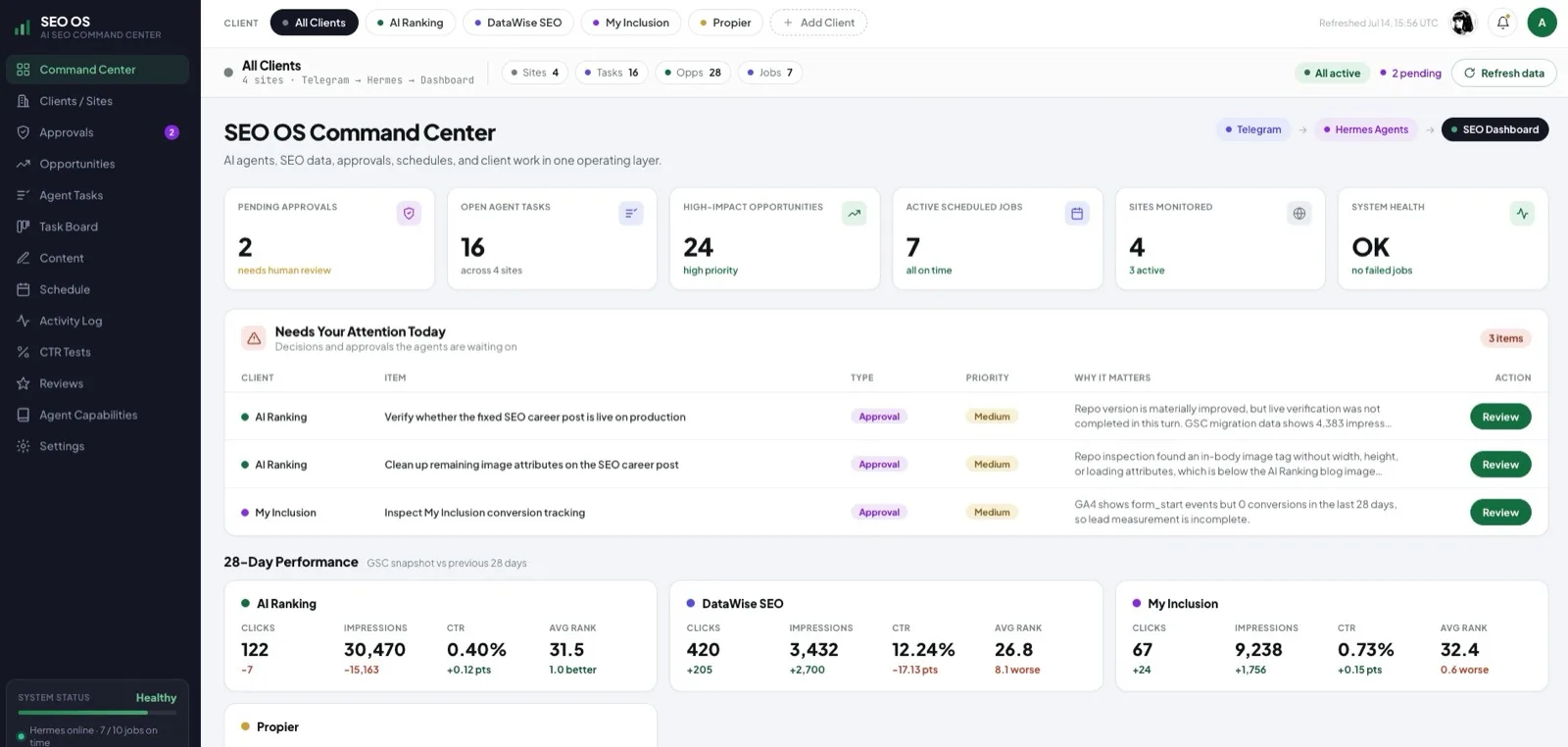
The dashboard has seven screens: Command Center (the overview), Opportunities, Approvals, Agent Tasks, CTR Tests, Schedule, and Reports. Your data stays yours: the deploy button creates the dashboard in your Cloudflare account with your database, and the agent on your VPS keeps it updated. It ships as a template with demo data, so you can click around before connecting anything real.
An agent without a dashboard is a black box you have to interrogate over chat. The operating board is what turns agent output into an operation: you see every proposal, approve from one screen, and clients can be shown real state instead of screenshots from a terminal.
How do I get Hermes running on my SEO? (the short version)
The full setup takes an afternoon: rent a small VPS, install Hermes Agent, connect a model, link Telegram, deploy the dashboard, and give the agent its first supervised task. Nothing about it requires being a developer, but it does require following steps in order.
- Rent a VPS. A $5 to $10 per month instance is enough; the agent is light.
- Install Hermes Agent. The official docs cover VPS, Docker and desktop installs.
- Connect a model. Hermes is model-agnostic: Nous Portal, OpenRouter, OpenAI or any compatible endpoint works.
- Link Telegram. This becomes your notification and onboarding channel.
- Deploy the SEO OS dashboard. One click to your Cloudflare account, a 2-minute browser setup, one command on the VPS.
- Load the SEO skills and run the first task with approval gates on. Start with opportunity scoring: it is read-only and shows value fast.
We teach the full build inside the community's SEO OS section, step by step with the exact repo above, and dedicated hub guides on the dashboard, the setup, the skills and the Hermes vs OpenClaw and vs Claude Code comparisons are rolling out here next.
Where do humans stay in the loop?
At every gate that touches a live site. The agent proposes; you approve. Titles, content, review replies and anything client-facing waits on the Approvals screen until a human clears it. Run this way, an always-on agent is safer than ad-hoc chat SEO, because every change is logged, reviewable and reversible.
The judgment layer is still yours to feed. The agent knows your Search Console data; it does not know that a client hates exclamation marks, that a service line is being discontinued, or which promise your market stopped believing years ago. That context lives in the client knowledge library you build up, and it is what separates an agent that compounds from an agent that produces plausible noise. The same rule we apply to Claude applies here: leave the loop and you get slop, stay in it and every run compounds.
Watch: Hermes doing our SEO (the full setup)
Everything on this page, shown live: the VPS, the Telegram onboarding, the dashboard, and the agent working through real tasks. This is the walkthrough we recommend before you build your own.
Learn Hermes SEO hands-on
Courses, two live calls a week, templates and DataWise. Everything you need to go from reading about it to ranking with it.
How we teach Hermes SEO
The full SEO OS build, live
Follow the exact VPS, Telegram and dashboard setup from the community's SEO OS section until your agent runs the five workflows end to end.
The dashboard and skills, ready to deploy
One-click deploy our open-source SEO OS dashboard to your own Cloudflare account, then install the same SEO skills our agent runs on.
Human-in-the-loop reviews
Bring what your agent proposes to the live calls. We review the approvals queue together, so you learn the judgment layer no agent gives you.
DataWise for Hermes SEO
Our in-house SEO tool helps you give your agent a clean audit baseline before it starts optimizing. It is included free with every paid membership, so you stop paying for five different tools.
See DataWise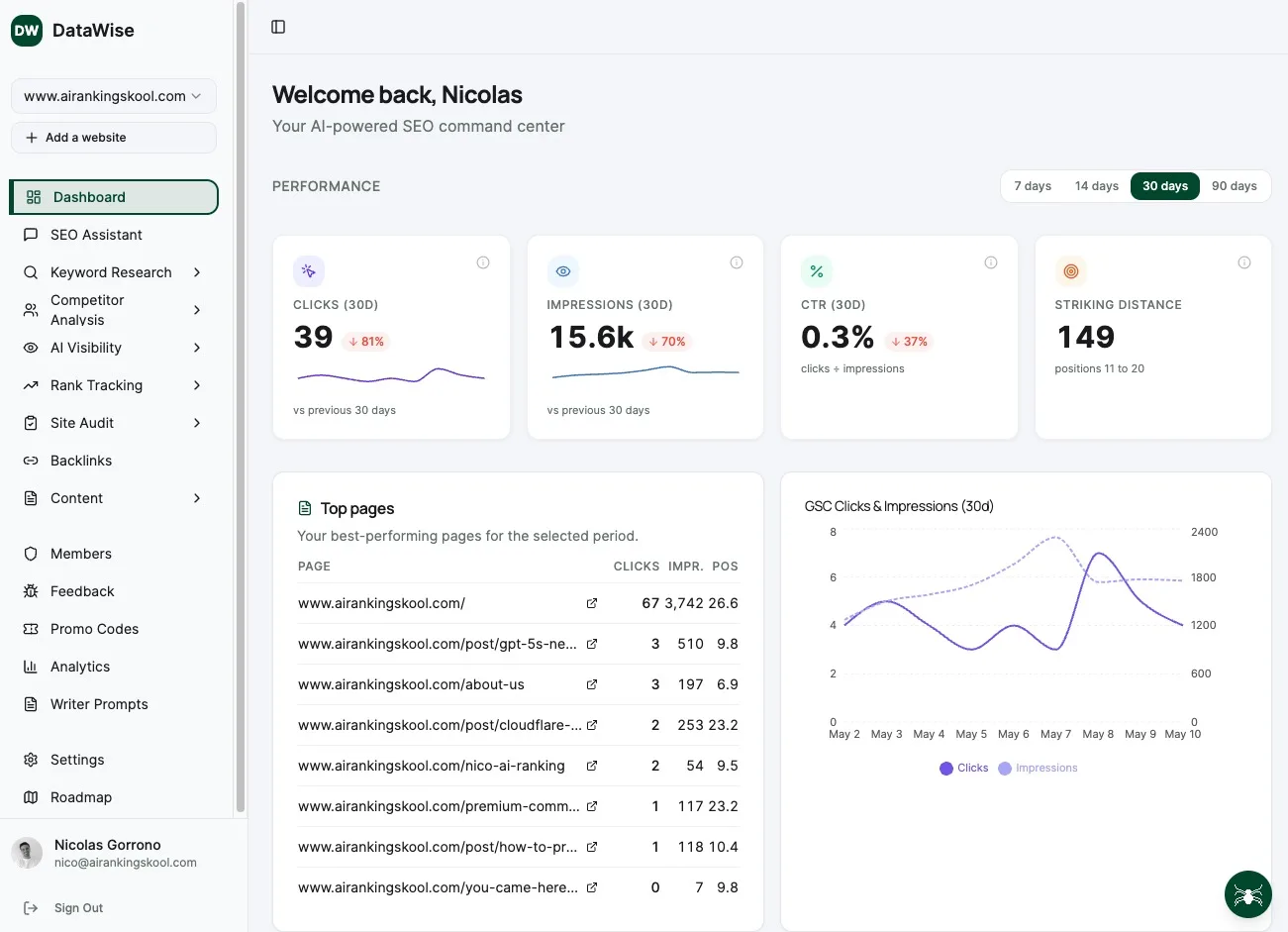
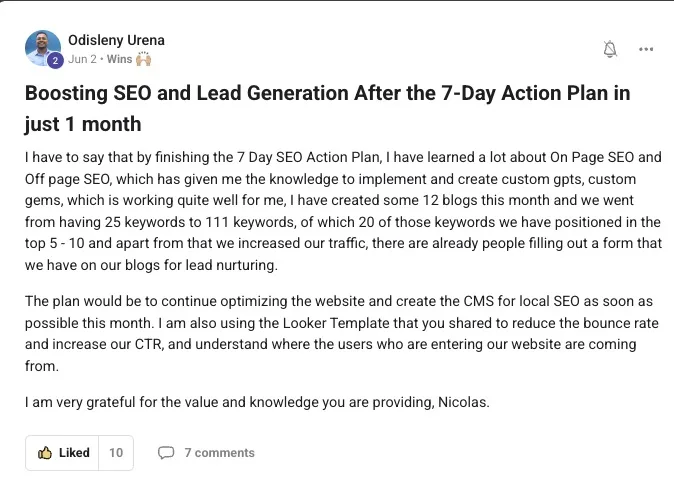
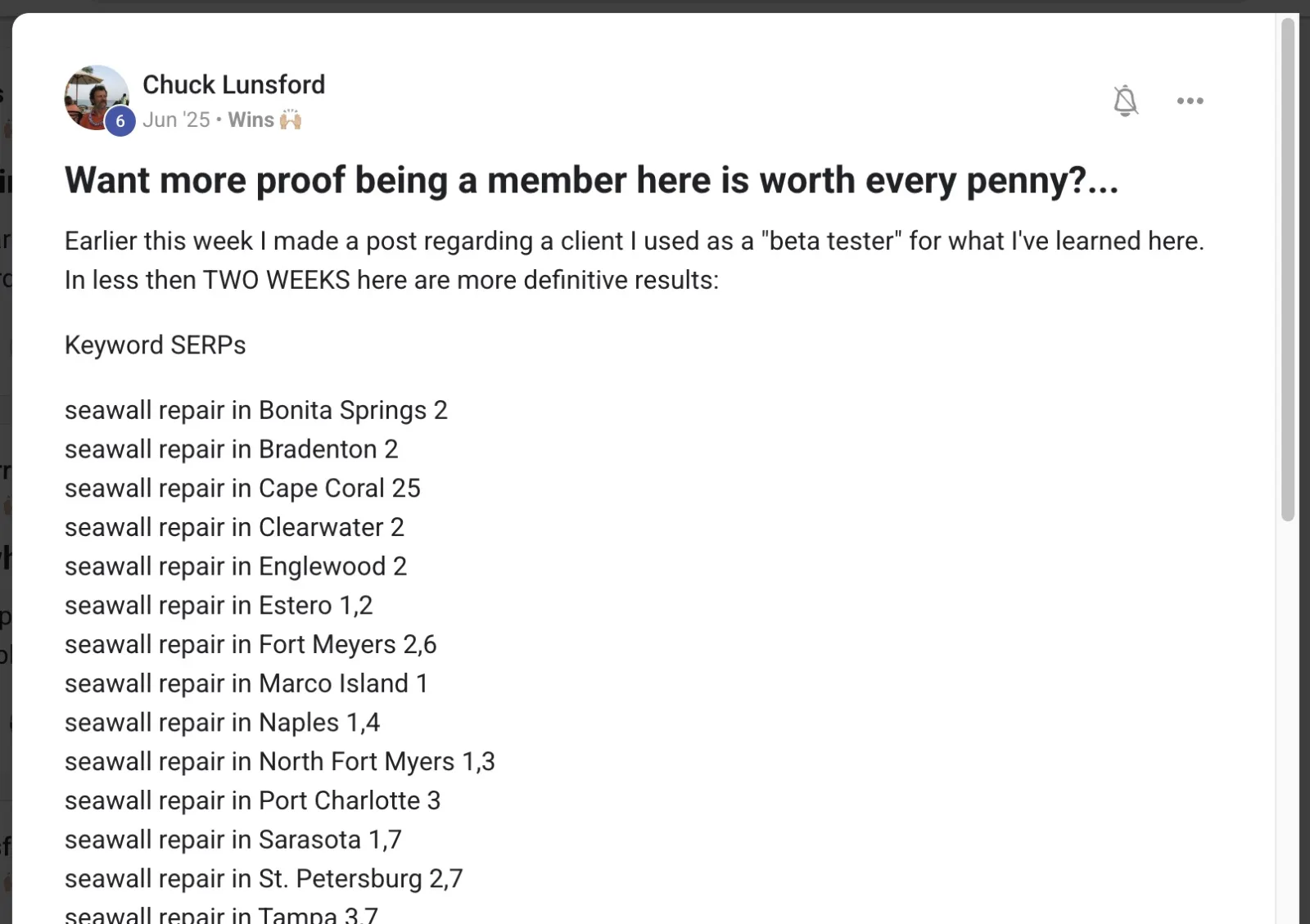
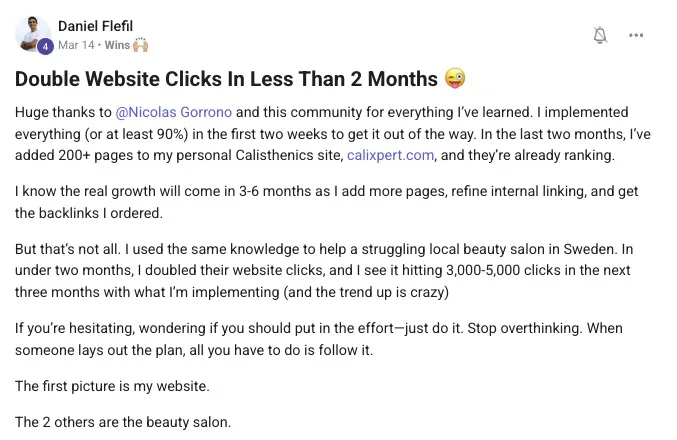
Hermes SEO wins from real members
Hermes SEO FAQ
What is the Hermes Agent used for?
Hermes Agent is a general-purpose autonomous AI agent from Nous Research: people use it for research, coding, operations and, in our case, SEO. It runs continuously on a VPS or your own machine, learns reusable skills from its own work, and communicates over Telegram and 20+ other platforms.
Is Hermes Agent free?
The agent itself is free and open source under the MIT license. You pay for what it runs on: a VPS around $5 to $10 per month and model usage through Nous Portal, OpenRouter, OpenAI or another endpoint, which for a typical SEO workload is usually in the tens of dollars per month.
Is Hermes Agent safe to use on my website?
It is as safe as the gates you run it behind. Our rule is that the agent never gets publish access: every title change, content draft and review reply lands on an Approvals screen first, and a human clears it. Set up that way, it is more auditable than ad-hoc AI chat work, because everything is logged.
Is Hermes Agent actually good, or just hyped?
Both things are true: the search interest is a hype wave, and the agent is genuinely capable. The honest framing is that agentic SEO is the durable practice and Hermes is its best current implementation. If a better agent replaces it next year, the SEO OS structure (dashboard, gates, profiles, schedules) transfers with you.
Can Hermes Agent search the web?
Yes, it can reach the web through its tools and skills. For SEO work we mostly feed it structured data instead: Google Search Console for performance and DataForSEO for keywords and SERPs, because scored decisions need clean numbers, not scraped pages.
What is the best model for Hermes Agent?
Hermes is model-agnostic, so pick by task: a frontier model for planning and content quality, a cheaper model for high-volume routine runs. Nous Research's own Hermes models through Nous Portal are the default starting point, and OpenRouter makes it easy to test alternatives on your actual workload.
How is Hermes Agent different from OpenClaw?
Both ride the same open-source always-on agent wave; OpenClaw peaked first (around 1 million monthly searches in early 2026, per DataForSEO) and Hermes followed with a stronger learning loop that turns completed work into reusable skills. For SEO, the honest answer is that the operating system around the agent matters more than which agent you pick.
Win at Hermes SEO with people who have your back
Join 7,400+ business owners, agencies and freelancers learning AI search engine optimization together.