SaaS SEO: How to Get Your Software Found and Shortlisted in AI Search
SaaS SEO now decides whether AI tools shortlist your product. The pages, signals and steps that get software found.

SaaS SEO is the work of getting your software found and shortlisted by buyers, first in Google and now in the AI chatbots they ask before they ever visit a vendor site. The core moves are the same as they have been for years: pages for every use case and integration, honest comparison and alternatives pages, and a product that people talk about in reviews and communities. What changed is that AI tools now do the shortlisting.
The data backs that up. In G2's 2026 AI search report, 71% of B2B software buyers said they rely on AI chatbots somewhere in software research, and 51% start their research with a chatbot more often than Google. That is G2's own survey, so weigh it as such, but the direction matches what the live search results show.
This guide is for SaaS founders and marketing leads, and for the freelancers and agencies who run SEO for software companies. It covers the SaaS SEO strategy that works in the AI search era, page by page.
What is SaaS SEO, and how is it different?
SaaS SEO is search optimization for subscription software companies, built around buyer intent rather than raw traffic. It differs from local or ecommerce SEO because the buyer researches for weeks, compares vendors side by side, and often asks AI tools to build the shortlist.
In live DataForSEO data for the US (November 2026), "saas seo" and "seo for saas" each get about 480 searches a month with a keyword difficulty of 12, and advertisers pay around $40 a click. "Saas seo consultant" gets 260, "saas seo strategy" 210 and "saas seo guide" 90. Small numbers, high value: the people searching them are usually responsible for a pipeline target.
When we checked the SERP, Google's AI Overview framed SaaS SEO as a dual job: rank in traditional search and get cited by AI answer engines. It also pushed bottom-of-funnel pages (comparisons, alternatives, use cases) ahead of generic blog content. That ordering is the right one.
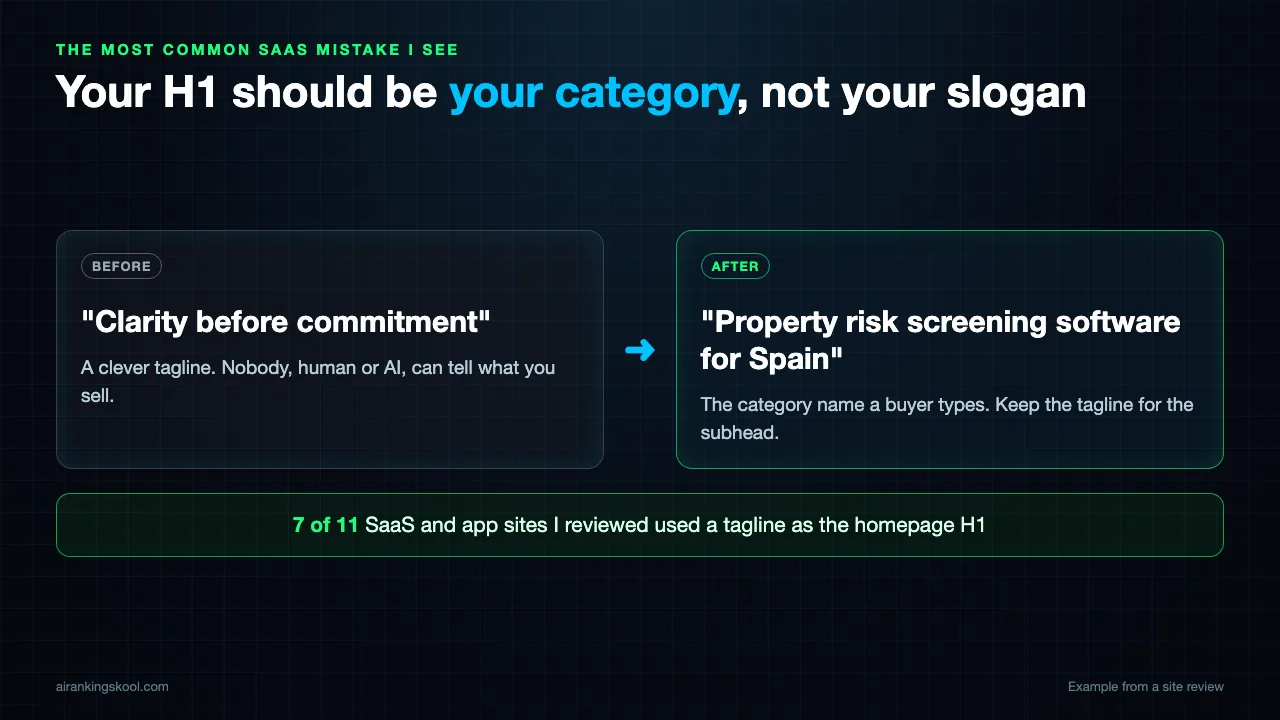
The most common mistake I see happens before any of that. In the SaaS and app websites I've reviewed, a clever tagline as the homepage H1 came up again and again, on seven of the eleven sites. "Clarity before commitment" tells nobody, human or AI, that the site sells property risk screening software for Spain. Lead with the category name a buyer would type, and keep the tagline for the subhead.
Which SaaS SEO pages drive pipeline?
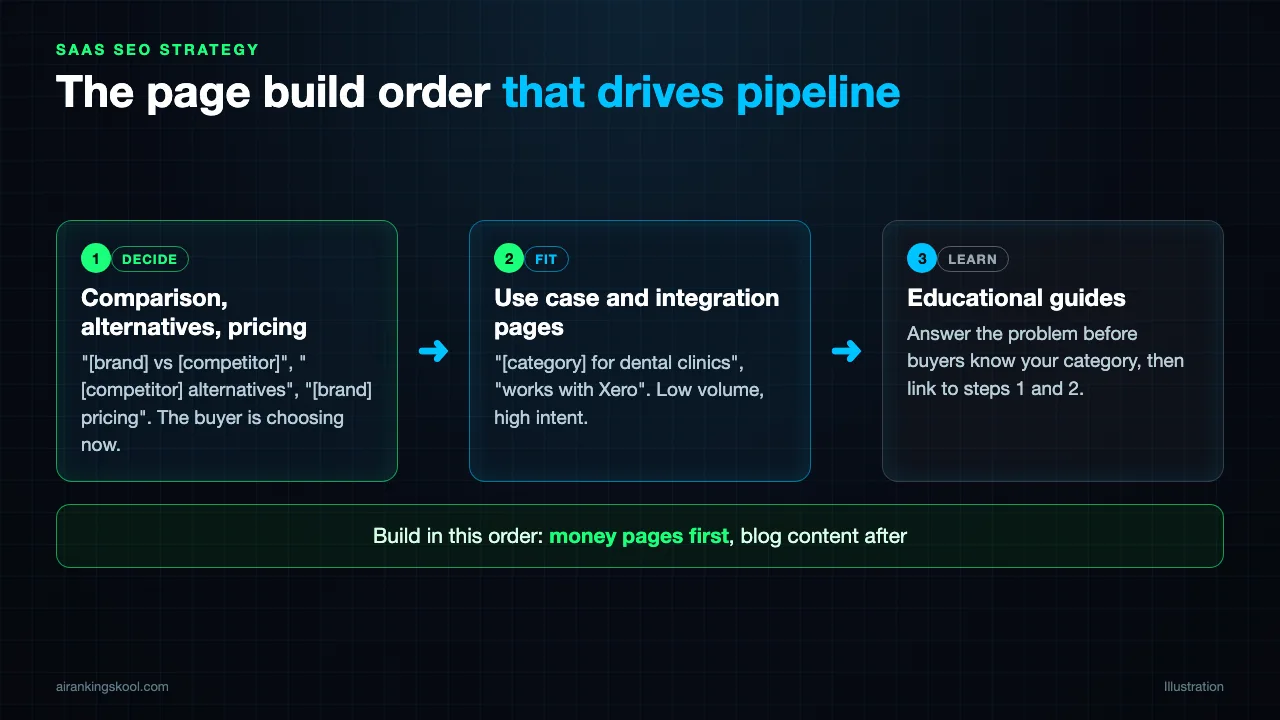
Comparison pages, alternatives pages, use-case pages and integration pages drive the most pipeline, because they match searches made by people already choosing a tool. Top-of-funnel blog posts support them but rarely convert on their own.
| Page type | Example search | Why it converts | What AI tools pull from it |
|---|---|---|---|
| Comparison | [your brand] vs [competitor] | The buyer is down to two options | Feature and pricing differences, who each tool suits |
| Alternatives | [competitor] alternatives | The buyer is unhappy with a tool they know | A clear list with honest fit notes |
| Use case | [category] software for [team or job] | Matches a specific problem | Who the product is for and what it does |
| Integration | [your category] for [Slack, HubSpot, Shopify] | The buyer already has a stack | Proof the product fits their tools |
| Pricing | [brand] pricing | Late-stage validation | Plan names, limits and current prices |
| Educational guide | how to [job your product does] | Builds trust earlier | Definitions and steps, with your product as an example |
Here's the thing about comparison and alternatives pages: they only work if they are fair. A page that says your product wins on every row reads as an ad, to buyers and to the AI tools summarizing it. Say plainly who the competitor is a better fit for. That honesty is what gets the page quoted.
Integration and use-case pages are where I see the most money left on the table. A restaurant POS company I reviewed worked with Xero, MYOB, Uber Eats and DoorDash, but had no page for any of them, so a restaurant owner searching for a POS that works with their delivery apps had nothing to land on. The same site had industry pages, but the coffee shop page still had the pizza page's photos and copy with the keyword swapped. Pages like that need to be genuinely different, at least half their content, or they don't get indexed.
These pages often show little or no search volume in keyword tools. Build them anyway. As I told one founder, they're going to be very low search volume, but they're the ones that make you money.
Be careful with scale, too. Google's spam policies name scaled content abuse: generating many pages mainly to manipulate rankings, including with AI, without adding value. Fifty "X alternatives" pages built from one template with the competitor name swapped is the pattern that policy describes. Ten well-researched ones are not.
Your pricing sends a positioning signal too. One AI visibility tool I reviewed charged around $200 a month while its homepage spoke to small businesses. At that price it was really an agency tool, so the site needed to either say so or add an entry-level tier. Buyers and AI tools both read your price as a clue to who you're for.
How does a SaaS product get onto ChatGPT's shortlist?
By being described consistently, accurately and often in the places AI tools read: your own site, review platforms, community threads, integration directories and comparison articles. AI answers summarize what the web says about you, so what the web says has to be clear.
G2's survey points to the same thing. In the same report, 45% of buyers said review site citations are the most confidence-inspiring signal in an AI answer, and 69% said AI chatbots surfaced information that led them to pick a different vendor than expected. Your shortlist position is now partly decided before anyone lands on your homepage.
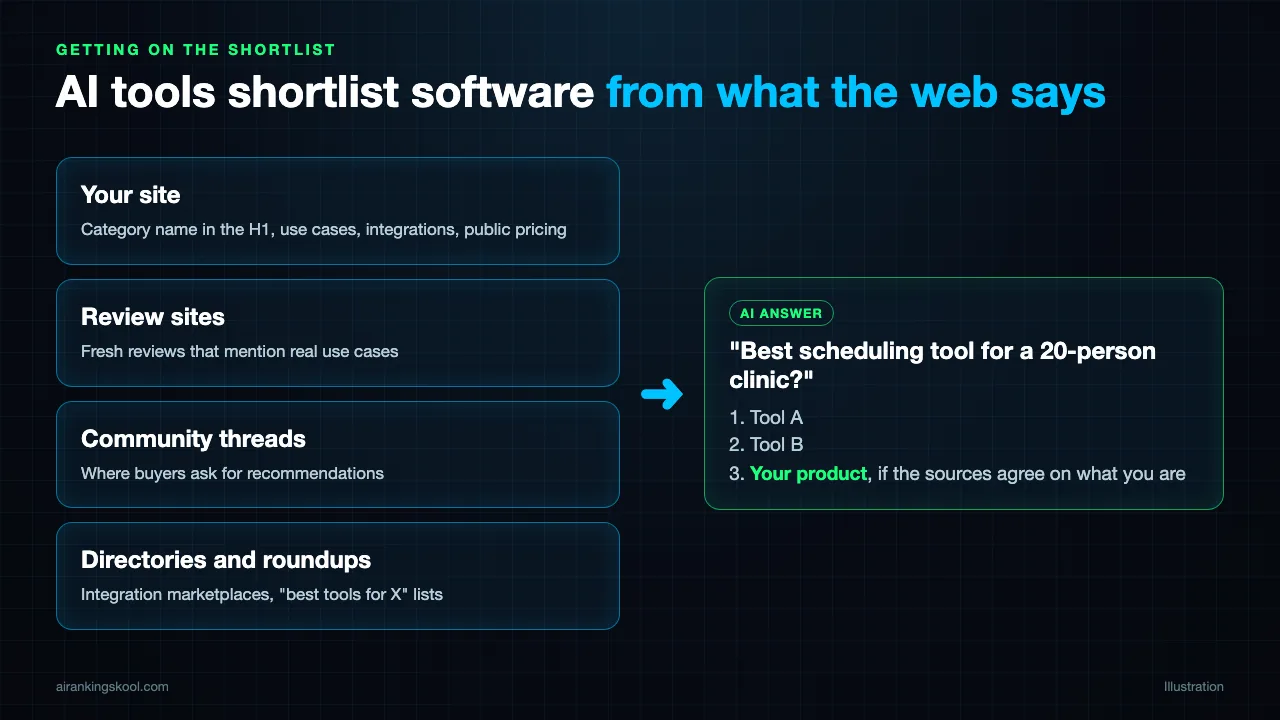
The practical checklist:
- Say what you are in one sentence on the homepage, in the same words you use on G2, Capterra, your LinkedIn page and your app marketplace listings. "Scheduling software for veterinary clinics" gets matched. "The future of work" does not.
- Keep review profiles current. Fresh reviews that mention specific use cases give AI tools something concrete to quote.
- Show up in community threads where buyers ask for recommendations, as a helpful person rather than a sales pitch. AI search tools read those threads too.
- Get listed in roundups and integration directories for your category. Those are the pages AI tools pull from when asked "what are the best tools for X".
- Publish your pricing and limits. If an AI tool cannot find your price, it will either guess or leave you out of a "cheapest option" answer.
When I audit a SaaS site for AI visibility, I look outside the site first. Is there a YouTube channel? A LinkedIn company page? A founder with a real profile and Person schema connecting the two? An appointment reminder tool I reviewed had good product videos, but they lived only on Vimeo, with no YouTube or LinkedIn presence for AI tools to find. Your brand needs to exist as an entity outside your own website.
Then test it. Ask ChatGPT, Perplexity, Claude and Google AI Mode the prompts your buyers would use, like "best [category] tool for a 20-person team", and log who gets named. Our ChatGPT ranking guide explains how those answers get built, and the query fan-out breakdown shows why one prompt triggers several hidden searches.
What does a SaaS SEO strategy look like, step by step?
Start at the bottom of the funnel, build the pages buyers use to decide, then earn the third-party mentions that make AI tools trust you. Educational content comes after the money pages, not before.
- Map the buyer's questions. List every competitor, integration, use case and job-to-be-done your sales team hears. Pull search volume for each so you can prioritize.
- Build or fix the money pages. Comparison, alternatives, use-case, integration and pricing pages, each with one clear purpose.
- Fix the technical basics. Make sure marketing pages render without heavy client-side JavaScript, the docs are crawlable, and AI crawlers are allowed.
- Add structured data. Organization, FAQ and product markup help search engines and AI tools extract the facts.
- Earn third-party proof. Reviews, community answers, integration partner listings, podcasts and roundups.
- Publish educational guides that answer the questions buyers ask before they know your category exists, and link them to the money pages.
- Measure pipeline. Trials, demos and revenue from organic and AI referrals, not just sessions.
On step 3, OpenAI says OAI-SearchBot is the crawler that surfaces websites in ChatGPT search and recommends allowing it in robots.txt. Blocking it by accident, often through a security tool's default bot rules, takes you out of ChatGPT's search results entirely. A technical SEO audit will catch that.
On step 4, Google documents SoftwareApplication structured data for software pages. It requires a name plus either a rating or a review, and it notes that a free app should set its price to 0. Only mark up ratings that are shown on the page and genuinely belong to your product.
This gets skipped more than you'd think. On a trading journal app I reviewed, the only structured data that validated was the breadcrumb. Nothing on the site told Google it was software at all.
Should a SaaS company still publish blog content?
Yes, but only content that teaches something your buyers need and connects to a product page. Generic "what is X" posts are the content AI Overviews answer directly, so they earn fewer clicks than they used to.
The posts that still work are the ones with something an AI summary cannot replace: original data from your product, a real workflow with screenshots, a template, or a strong opinion from someone who has done the job. Google's guidance on helpful content asks whether your content offers original information, research or analysis. For a SaaS company, your own product data is the easiest place to find that.
Source your own claims, too. A reminder app I reviewed said on its blog that its messages got open rates above 90%, with no source and no named author. A line like that costs more trust than it earns. Show the screenshot, name the data, and put a real person's name on the post.
Keep each post tied to a money page with a natural internal link. If you want a deeper framework for writing pages that get cited, our GEO guide covers the structure: a direct answer first, then the detail.
How do you measure SaaS SEO?
Measure organic and AI-referred trials, demos and revenue, plus how often your product is named in AI answers for your category prompts. Traffic is a leading indicator at best.
- Pipeline by landing page: which comparison, use-case and integration pages produce trials and demos.
- AI referrals: sessions from chatgpt.com, perplexity.ai and similar referrers in your analytics.
- Share of AI answers: a monthly log of 20 to 30 category prompts across the major AI tools, recording whether you are named, cited or missing.
- Search Console: impressions on bottom-of-funnel queries, which often rise before clicks do.
For the AI Overview part of that, our guide on checking your AI Overview exposure has a free method you can run on your own keywords.
When does a SaaS company need a SaaS SEO consultant?
When you have a content team or agency shipping work but no clear plan for AI search, or when you are being left off the AI shortlists your competitors appear on. A consultant brings the strategy and the review. Your team does the work.
That is exactly how our SaaS SEO consulting is set up: an audit of where you appear in AI answers today, a page-by-page roadmap your team can execute, and regular reviews. It suits established software companies with a site, some traffic and someone to implement.
If you are an early-stage founder or a freelancer learning SaaS SEO, the AI Ranking community teaches the same playbook with templates and weekly help.