Google Is Eating Its Own Search Ads: What AI Mode's Money Problem Means for You
AI Mode earns Google less per search, so more ads are coming to AI answers. What it means for your clicks.
Google search revenue still grew 12% in Q3 2026, but Google admitted its new AI Mode makes less money per search, and its fix is to push more ads into AI answers. Most coverage stopped at the stock price. The bit that matters for you is what happens next to your clicks.
Most people read "five-year high in search growth" and assume Google is fine, so websites are fine. Not quite. More searches are moving from the classic results page into AI answers, those answers earn less, so the ads are moving in. Every step of that squeezes the free clicks that used to reach your site.
In this post you'll get what Google actually said on its October 28 earnings call, why AI Mode earns less, my read on where this loop goes, and a five-step list for this month. It's written for local business owners, freelancers and agencies, not investors.
What did Google say about AI Mode and Google search revenue in Q3 2026?
Google search revenue rose 12% to $63.35 billion in Q3 2026, and search query growth hit its highest rate in five years. On the earnings call, Google's business chief also said fast-growing AI Mode queries weighed on Search because AI Mode earns less money.
The numbers come straight from Alphabet's Q3 2026 release, filed with the SEC on October 28, 2026. The release says Google Services grew 11% to $96.3 billion, "led by 12% growth in Google Search & other with the year-over-year Search query growth rate the highest it has been in the last five years." Here's the side-by-side.
| Line (Alphabet Q3 release) | Q3 2025 | Q3 2026 | Change |
|---|---|---|---|
| Google Search & other | $56,567M | $63,350M | +12% |
| Google advertising (Search, YouTube ads, Network) | $74,182M | $82,012M | about +10.6% (our math) |
| Google Services total | $87,052M | $96,302M | +11% |
| Alphabet total revenues | $102,346M | $127,577M | +25% |
| Search query growth | Not disclosed | Not disclosed | "the highest it's been in the last five years" |
The release itself never mentions AI Mode. That came on the call. Asked why Search slowed when queries were booming, Chief Business Officer Philipp Schindler said, per the earnings call transcript: "it's worth noting that the strong growth in AI Mode queries had an impact because of the lower monetization we were seeing in AI Mode."
Be fair to Google on one point. Schindler named currency swings first: "First, there was FX. It was the single largest driver of Search deceleration relative to Q2." He also pointed to retail and to media spend settling after the World Cup. As Search Engine Land noted, Google didn't disclose how much AI Mode contributed to the slowdown. So AI Mode isn't the whole story, but Google put it on the record.
Why does AI Mode make Google less money per search?
Most likely because AI Mode answers carry fewer ads than a classic results page so far, which is exactly what an analyst asked Google on the call. Google hasn't published how much less one AI Mode search earns, only that it had an impact on Q3.
JPMorgan analyst Doug Anmuth asked it straight on the call: "Is it simply that you haven't been showing as many ads, basically, in AI Overviews and AI Mode, and that's now becoming a bigger percentage of the overall queries?" CEO Sundar Pichai had already set out the order of priorities: "Just like our shift to mobile over a decade ago, we are focused on building the best Search user experience, followed by monetization."
In plain words (my read, not Google's): a classic results page has had heaps of years to fill up with ad slots. AI Mode is a newer, chattier screen. Pichai said queries there are "on average three times longer than traditional searches", and Google is only now scaling ads into those answers. So when a bigger share of searches moves into AI Mode, the average search earns less.
Google's spin is that this is upside. Schindler said "the majority of AI Mode queries are incremental, creating more monetization opportunities over time." Search Engine Land pointed out Google gave no figures to back that up. No one outside Google knows the revenue per AI Mode search, so treat any number you see quoted as a guess.
Why is Google a snake eating its own tail?
Picture an ouroboros, the old symbol of a snake swallowing its own tail. That's how I read Google's position right now. To be clear, this is my thesis, not something Google said. The first four steps are on the record. The last steps are my prediction.
- AI Mode grows searches. Google says query growth is the highest in five years, and Schindler called AI Mode query growth "strong".
- Those searches earn less. Schindler's own words: "the lower monetization we were seeing in AI Mode."
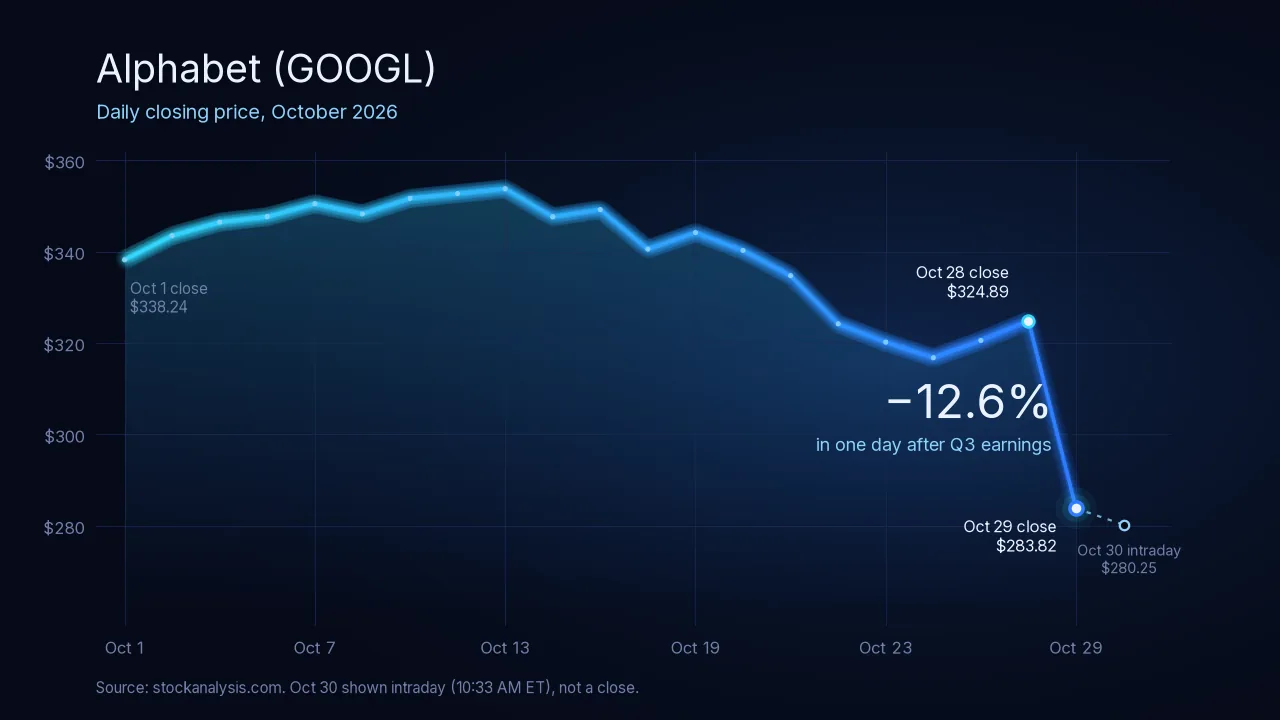
- Wall Street punishes it. CNBC reported Alphabet shares fell "close to 10% in after-hours trading" after the report.
- Google adds ads to the AI answers. Schindler: "we are now scaling high-quality ads within AI Overviews and AI Mode to more users and queries. This includes taking our monetization footprint global for the first time."
- The answer plus the ads take more of the screen (my read). Fewer free clicks are left for websites.
- Fewer clicks means fewer reasons to publish (my read). Businesses stop writing the useful pages AI answers are built from, and the answers get thinner.

So here's my firm call: Google will flood AI Mode with ads. It has a revenue gap to close and Wall Street watching every quarter. The catch is that AI answers are built on the open web. Starve the sites of clicks and, sooner or later, the snake is chewing on its own tail.
Will that break Google next quarter? No. Google still grew Search 12%. But it changes what a click from Google is worth to you, and that's the part you can act on.
Where are the organic clicks going?
Fewer of them leave Google, because the AI answer now does the job a click used to do. Reddit's CEO says AI Mode doesn't drive traffic to Reddit, so check your own clicks instead of assuming you're safe.
On Reddit's Q3 call on October 29, CEO Steve Huffman didn't mince words: "The reality is the AI Mode does not drive traffic. Not for us, and not to anybody as far as I know." He added that during October, Reddit's "search traffic has dropped by more than 1 million referrals on average per week."
That's Reddit, not you, mind you. A plumber or a bookkeeper has a different mix of searches. But it's a loud public signal that AI Mode keeps people on Google.
The useful move is to look at your own data. Start by learning to check your own clicks vs impressions in Search Console: impressions holding while clicks fall is the pattern to watch. For the bigger picture on why organic clicks keep shrinking, I've covered that separately, so I won't repeat it here.
Will Google keep adding ads to AI Mode to protect search revenue?
Yes. Google said on the call that it's scaling ads in AI Overviews and AI Mode to more users and more queries, taking AI Mode ads into international markets and adding ads to follow-up questions in the US.
Schindler laid it out on the call: "Today, we are announcing the expansion of ads in AI Mode into international markets alongside multi-turn ads in AI Mode in the U.S." He framed the pace as "deliberate," with user experience first, "and then scaling the formats that drive proven ROI for advertisers."
He also said "Click-through rates are already similar between sponsored and organic product list items within AI Mode." Treat that one carefully. It only covers product listings, and Google didn't share any actual click-through rates or how it measured them, as Search Engine Land flagged.
The ads show as "Sponsored" placements inside or beside the AI answer, and I've already covered what AI Mode ads look like and how to check your account, so I won't rehash it. Put Google's words together with the revenue gap and I reckon you'll see more ads in AI answers every quarter from here.
What does this mean for a local business, freelancer or agency?
Free informational clicks from Google will keep thinning, so your job is to be the business AI answers name and the one people search for by name. On the paid side, Google hasn't said what this does to ad prices, so watch your cost per lead.
Organic. The "how do I fix X" searches are the first to stay on Google. The searches that still turn into money are people looking for you by name, people checking your Google Business Profile and reviews, and people who already know you from somewhere else. That's demand Google can't easily eat.
Paid. More ad space inside AI answers is coming, per Google. What it does to your cost per click or cost per lead, Google hasn't said, and I'm not going to guess. Judge it on leads and booked jobs, not clicks.
Freelancers and agencies. Set client expectations now. If you report on organic clicks alone, a client can see a drop while leads hold steady, or the other way around. Report clicks, impressions and leads side by side so nobody panics over the wrong number.
What should you do this month?
You don't need a new strategy, just a sharper version of the one that works. Five steps, in order:
- Baseline your clicks vs impressions. Pull the last few months for your top service pages in Search Console, using the steps in our AI Overview tracking guide. You can't spot the squeeze without a before.
- Judge Google Ads by cost per lead. If you run ads, AI Mode traffic can look different from classic search. Run the account check in our post on ads inside AI Mode and compare leads, not clicks.
- Make your service pages easy to cite. Clear prices or price ranges, service areas, hours and real FAQs. That's the core of AI Mode SEO. For the why, see how AI answers pick the businesses they cite.
- Build demand Google can't eat. Treat your Google Business Profile like a social profile: post often, add images, and interact hard with reviews and questions. Understand you're optimizing the whole entity, not just a website or even just the GBP. And start a YouTube channel today. Our local SEO basics cover the GBP side.
- Track whether AI answers mention you. Rankings alone don't show it. DataWise, our in-house SEO tool, has AI visibility tracking, so you can see if AI answers name your business and watch it over time.
If I had to pick one, it's step 4. A business people know by name, across Google, YouTube and its profile, is the hardest thing for an AI answer to replace.
Want help applying this to your own site? Inside AI Ranking Premium we run live Q&As and website reviews, so you can bring your Search Console and we'll look at your clicks together. Not ready for that? Start with the free AI Search Kickstarter.
Is SEO dead if Google keeps eating its own clicks?
No. People have said SEO is dead since the 90s and it's still here, because it keeps evolving: now the target is being the business AI answers name and the one people search for by name.
Either it's the longest death in the world, or people don't realize SEO just keeps evolving. I'm going with the second one. There's always a place to optimize how your brand and your entity get seen online, whether that's a results page, an AI answer, a map listing or a YouTube search.
Google eating its own clicks changes where you show up, not whether it's worth showing up. Get your baseline, build the brand, and keep an eye on those leads.
Cheers,
Nico