Jev for SEO: I Tested TypeSafe's Decision Model on 3 Real SEO Jobs
Jev can't write a word, but it can make thousands of small SEO decisions for pennies. Three real tests on two live sites, with the numbers, the costs, where it was wrong, and three free skills.

Jev for SEO means using TypeSafe's Jev, a model that makes decisions instead of writing text, for the thousands of small judgement calls in SEO: which page a paragraph should link to, which page should own a search, and whether ChatGPT recommends you. I ran it on three real jobs on two live sites. The model was cheap and fast, the results were useful, and the part that made it work was not the model.
Every other guide I found describes what Jev could do for SEO. This one shows what it actually did: the numbers, the costs, where it was wrong, and three free Claude Code skills so you can run the same tests on your own site.
What is Jev, and why does it matter for SEO?
Jev is a decision model from TypeSafe AI: you give it some text and a question with fixed answer options, and it returns a probability for each option. It can't write a word, so it's cheap and fast for SEO work made of small decisions.
TypeSafe launched Jev in September 2026 and calls it a "System One" model, a nod to the psychology idea of fast intuition versus slow, careful reasoning. Claude and ChatGPT do the slow kind. Jev only does the fast kind. TypeSafe's launch post prices it at $0.042 per million input tokens with free output, and quotes response times of 70 to 500 milliseconds.
That matters for SEO because a lot of the work is not writing. It's deciding: which page to link, which page to keep, which keyword belongs where. Most people have been paying a writing model to make those calls, one expensive paragraph at a time.
How does Jev actually make decisions?
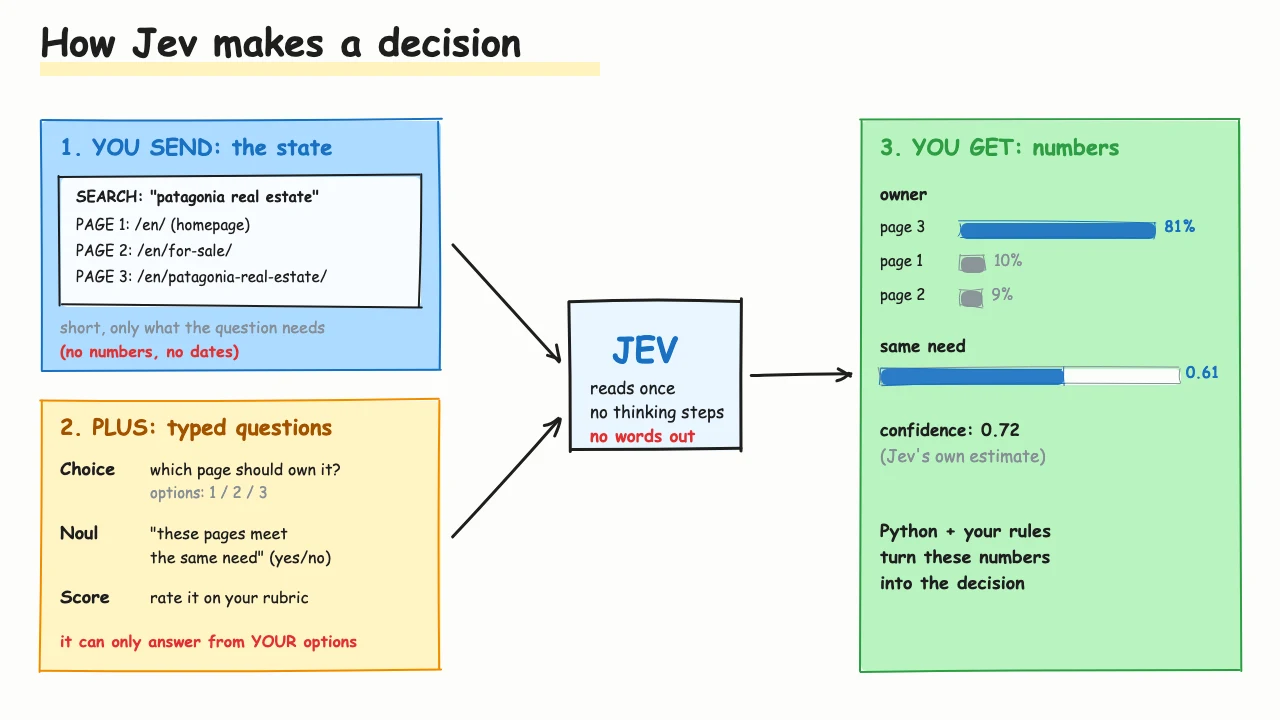
Jev reads the text you send once and returns a probability for every answer option, with no thinking steps and no written explanation. It was trained to make those probabilities honest, and TypeSafe grades it by how often it agrees with two frontier models.
Every call has two parts. The state is the context: a paragraph, a search query, a few page titles. The questions are typed, and TypeSafe's documentation lists three kinds: a Choice (pick one option from a list), a Score (rate against a rubric) and a Noul (a yes-or-no statement returned as a probability from 0 to 1).
On training, TypeSafe describes a method it calls RLCD, reinforcement learning for calibrated decisions, and says it tests Jev against "the average of the smartest models (in this case, Astra and Fable)." So it's best understood as a small, fast model tuned to make the gut calls a big model would make. It reads, but it doesn't reason.
What can't Jev do?
Jev can't write, it's weak at arithmetic and dates, and its accuracy drops when you give it large amounts of irrelevant text. It can also only choose from the options you give it, so it can't invent an answer.
TypeSafe is unusually open about this. Its Jev 1.13 weak-points page says "Jev is not a calculator," that it "reads dates as text, not as ordered quantities," and that "accuracy falls as the state grows with content unrelated to the decision." The advice is to keep arithmetic in code and send only what the question needs.
That rules out the thing most SEOs would try first: pasting a Search Console export into Jev and asking which pages are declining. That's numbers, dates and a big pile of rows. So in every test below I used the same rule: Python handles the numbers, Jev judges what the words mean, and Claude does the writing.
Can Jev find internal links for you?
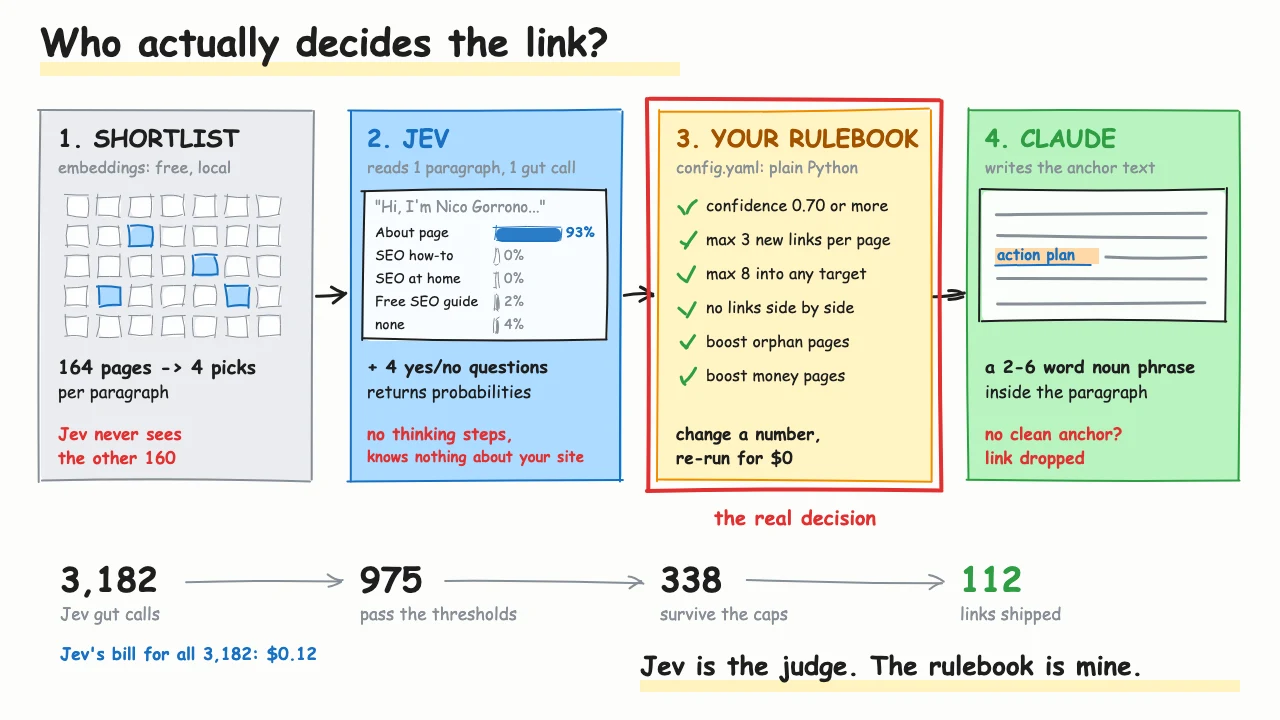
Yes. On airankingskool.com, Jev judged 3,182 paragraphs for $0.12 and, after my rules and my own review, produced 109 internal links worth adding. It worked because Jev only picked between four shortlisted pages per paragraph, and rules I wrote decided what survived.
Internal links matter because Google uses links as a signal for relevance and to discover pages. The problem is scale: this site has 164 pages and 3,863 paragraphs, which is over 600,000 places a link could go. Nobody reviews that by hand.
The pipeline had four layers:
- Shortlist (free): a small embedding model on my laptop picked the 4 most related pages for each paragraph.
- Jev: one call per paragraph asked which of the 4 pages is the most useful next step, or none, plus whether the paragraph needs a link and whether it contains a natural anchor phrase.
- Rules: Jev had to be at least 70% sure, no page got more than 3 new links, and no page received more than 8.
- Claude: picked anchor text that already exists in the paragraph, word for word, so nothing gets rewritten.
My first run proposed 147 links. I reviewed every one, approved 109 and rejected 38. The rejections are the useful part: links that used a hub page's own main keyword to point at a competing post, anchors sitting inside quoted prompts, and targets that were technically related but misleading. The review step is not optional.
I also made a mistake worth copying. My first anchor prompt produced phrases like "LLM SEO is the work": technically in the paragraph, useless as a link. Requiring a 2-to-6-word noun phrase cut the list roughly in half and made every remaining anchor usable. When I re-ran the same site on two different days, Jev made the same pick 96.7% of the time.
The whole thing is packaged as the free jev-internal-links skill for Claude Code. Point it at a sitemap and it produces a report you approve from.
Can Jev detect keyword cannibalization?
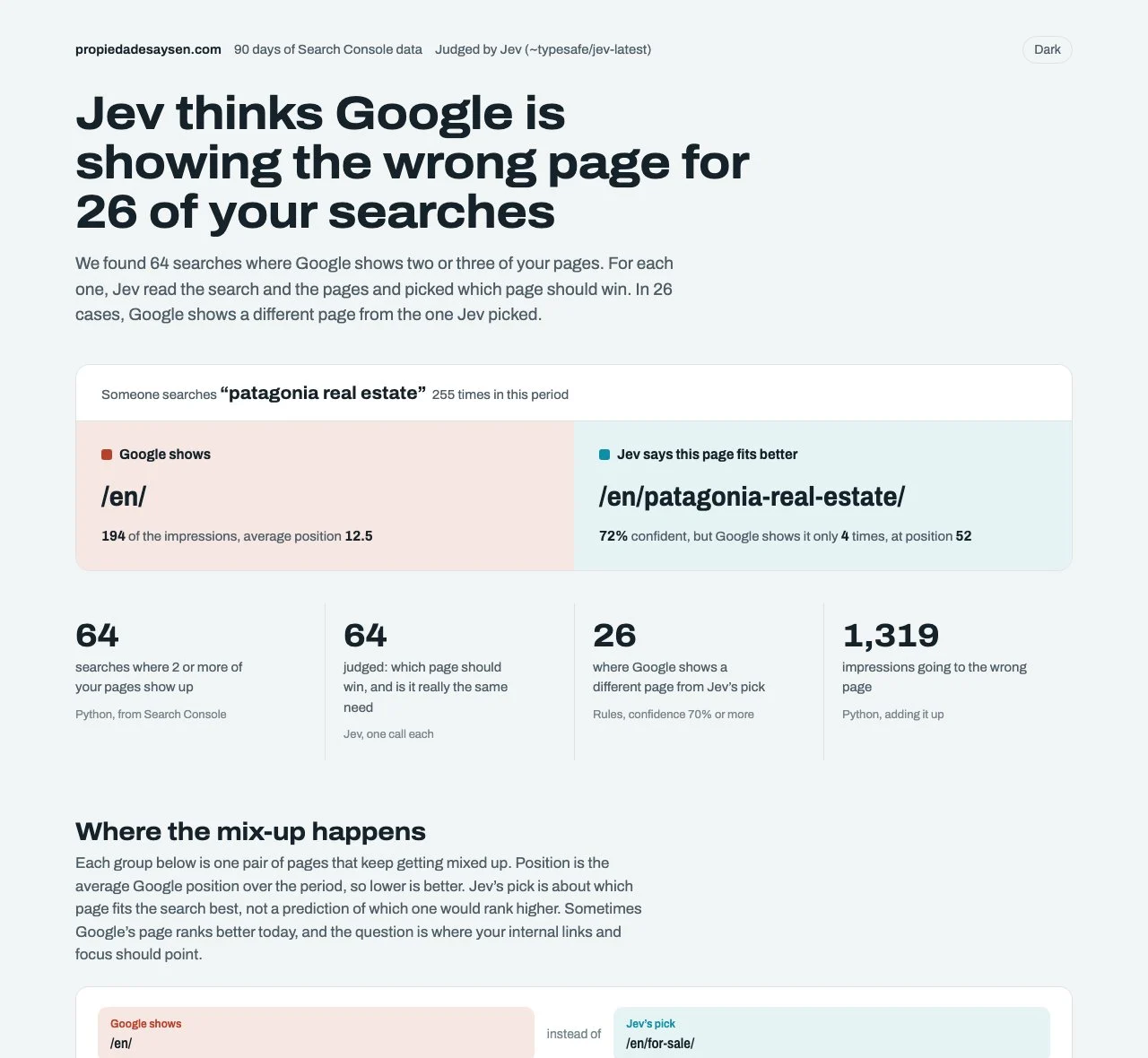
Yes, and it works best when Search Console finds the overlap and Jev only judges which page should win. On a Patagonia property portal I work on, it flagged 26 of 64 overlapping searches where Google shows a different page from the best fit.
Most cannibalization tools guess from page titles. Search Console already shows the real thing: searches where Google keeps showing two or more of your pages. I pulled 90 days of query and page data for propiedadesaysen.com through Windsor.ai, and Python found 64 searches where at least two pages each got impressions.
For each one, Jev read the search plus a short snapshot of each page (title, H1, meta description, opening text) and answered three questions: which page should own this, do the pages really serve the same need, and what should you do about it. Rules turned the answers into four outcomes:
- 26 wrong page winning: Jev was 70%+ sure a different page fits better than the one Google shows most.
- 19 not sure: under 70%, so a person reviews them.
- 18 right page already winning.
- 1 splitting signals: the right page wins, but a rival page competes for the same need.
The clearest example: "patagonia real estate," searched 255 times. Google showed the English homepage 194 times at an average position of 12.5. Jev gave the dedicated Patagonia real estate page an 81% probability of being the right owner, a page Google had shown only 4 times, at position 52. The biggest pattern was the homepage taking 14 "for sale" searches that the for-sale page should own: 633 impressions going to the wrong page.
Here's the honest part. Jev was confident about which page should win, but rarely about how to fix it. When I asked it to choose between leave, strengthen, differentiate or merge, only 3 of 64 suggestions reached 70% confidence. So the fix stays a human decision, which is right anyway: merges and redirects are hard to undo. The Jev bill for all 64 searches was $0.003.
Try it with the free jev-cannibalization skill. It takes a Search Console export, or pulls the data itself if Windsor.ai is connected to Claude.
Can Jev tell you whether ChatGPT recommends your business?
Yes. Jev read 40 real ChatGPT answers about Patagonia property and found the site mentioned in 11 and recommended in only 2. Its "mentioned or not" call matched a plain text search on all 40 answers, and on top of that it told me how the site was treated.
I pulled 40 real ChatGPT answers to buyer questions, 20 in Spanish from Chile and 20 in English from the US, using DataForSEO's ChatGPT results, at $0.004 per answer. Nobody is going to read 40 long answers carefully, let alone 400. Jev read each one and judged:
- whether the site is mentioned at all
- whether it's recommended, listed with others, or only used as a source link
- which business the answer sends the reader to first
ChatGPT's most common first picks were a local agency, Campos Patagonia, and the national portal Portalinmobiliario, 5 answers each. It also found 8 answers where the site isn't mentioned but plausibly should be, such as "dónde buscar casas en venta en Coyhaique" and "patagonia real estate for sale."
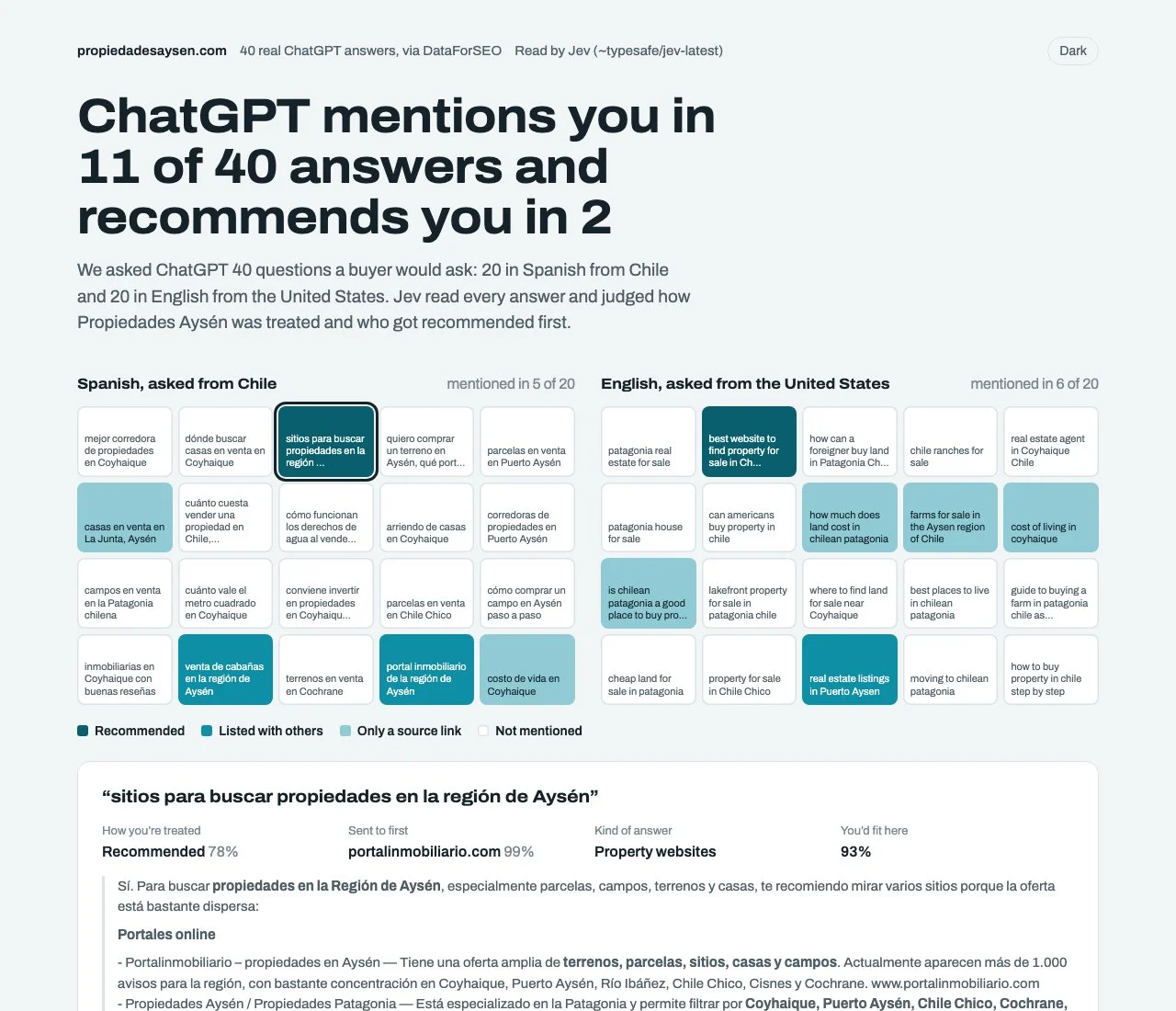
Before trusting it, I checked the one thing that needs no judgement: a plain text search for the domain in every answer. Jev's "mentioned or not" matched on 40 of 40. The text search tells you whether you're there. Jev tells you how. It also can't invent a competitor, because it can only pick names that appear in the answer, which is exactly what you want here.
Run it on your brand with the free jev-chatgpt-visibility skill. Forty answers cost about 16 cents to fetch and a fifth of a cent for Jev to read.
Which SEO jobs is Jev good at, and which should you avoid?
Jev is good at SEO decisions with a short, fixed list of answers where the evidence is words, not numbers. Avoid it for anything that needs arithmetic, date comparison, writing, or an irreversible call like a redirect.
| SEO job | Fit | Why | What it cost me |
|---|---|---|---|
| Pick an internal link target from a shortlist | Good | A choice between a few pages, judged on meaning | $0.12 for 3,182 paragraphs |
| Decide which page should own a search | Good | Search Console finds the overlap, Jev judges fit | $0.003 for 64 searches |
| Classify how an AI answer treats your brand | Good | Pure text reading with fixed labels | About $0.002 for 40 answers |
| Label the intent of a keyword list | Good | Fixed labels, short input | Not tested |
| Find declining pages in Search Console | Avoid | Numbers and dates, its documented weak spots | Use code instead |
| Write titles, anchors or content | Can't | Jev returns no text | Use Claude |
| Decide whether to merge or redirect | Human | Jev was rarely confident, and it's hard to undo | 3 of 64 reached 70% |
Is Jev better than Claude or ChatGPT?
No. Jev is cheaper and faster, not smarter: independent testing puts it level with mid-price models and behind the frontier. What made it accurate in my tests was breaking each decision into small questions.
An independent eight-day review found Jev "level with mid-price LLMs and 6.5 to 11.5 points behind the frontier," and points out that TypeSafe's own 67.8% figure measures agreement with two frontier models, not correctness against human labels.
The most useful finding comes from an independent phishing benchmark on 2,000 emails. Asked the single question "is this phishing?", Jev scored 62.6%. Asked five narrow signal questions in the same call, with the answers combined by a simple scoring model fitted on labelled emails, the result reached 95.1%. Same model, same emails. Only the questions changed.
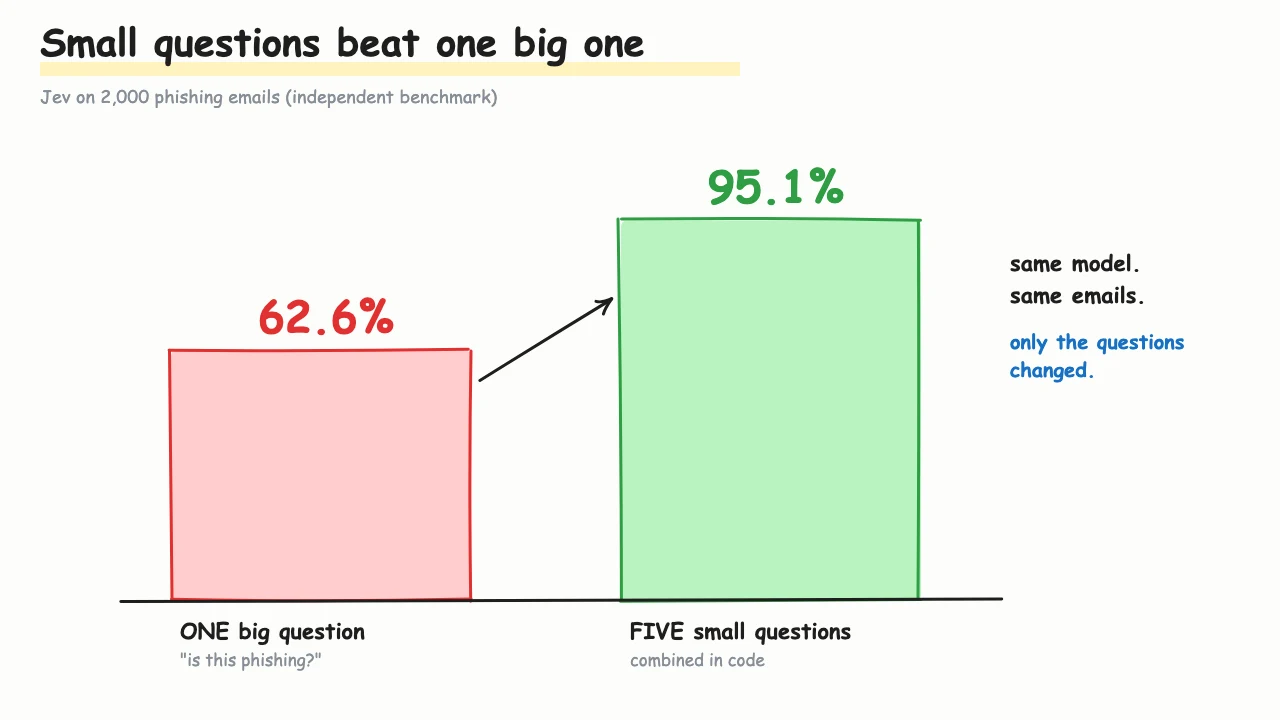
That's the pattern in all three of my tests. None of them asks Jev "should I add this link?" or "is this cannibalization?". They ask narrow questions and let plain rules combine the answers. If you take one thing from this post, take that.
How much does Jev cost, and how do you get access?
Jev costs $0.042 per million input tokens with free output, and you can use it today through OpenRouter without joining TypeSafe's waitlist. In my runs, individual decisions cost fractions of a cent and came back in about half a second.
That price comes from TypeSafe's launch announcement. Through OpenRouter I measured a median response of roughly 0.4 to 0.5 seconds, with slow calls around 2 seconds, a little slower than TypeSafe's quoted 70 to 500 milliseconds because OpenRouter adds a hop. One thing trips people up: Jev isn't a chat model, so it uses OpenRouter's /api/alpha/decisions endpoint, not the usual chat completions one. The skills handle that for you.
To run any of the three tests, install Claude Code, add an OpenRouter API key, and clone the skill you want:
- jev-internal-links: needs a sitemap, about $1 for a 150-page site.
- jev-cannibalization: needs Search Console query and page data, under a cent.
- jev-chatgpt-visibility: needs a DataForSEO account, about 20 cents for 40 answers.
Two cautions. Jev's answers vary a little between runs, so every skill caches its answers to keep each report reproducible. And TypeSafe's API terms are still early access, so check them before running client data through it. For more on building these workflows, see our guide to Claude for SEO, the SEO AI agents guide, and how AI search engines pick sources. Or bring your questions to the free AI Ranking community.
FAQ
Can Jev write SEO content?
No. Jev returns choices, scores and yes-or-no probabilities, never text, so pair it with Claude or another writing model for titles, anchors and pages.
How much does it cost to use Jev for SEO?
Jev costs $0.042 per million input tokens and output is free. In my tests, 3,182 internal-link decisions cost $0.12 and 64 cannibalization decisions cost less than half a cent.
Is Jev more accurate than Claude or ChatGPT?
No. Independent testing puts it level with mid-price models and behind the frontier, so its advantage is speed and cost on small, well-defined decisions.
Do I need the TypeSafe waitlist to try Jev?
No. Jev is available through OpenRouter without a waitlist, using OpenRouter's decisions endpoint rather than the normal chat endpoint.