What's really wrong with small business websites
Over twelve months we reviewed 439 live websites on camera, page by page. This report counts what kept coming up, how often, and what to fix first.
Six things the data says
- 9
The median website had nine problems worth fixing. We logged 4,043 issues across 439 sites. Only 11 sites (2.5%) were rated strong with little to change.
- 75%
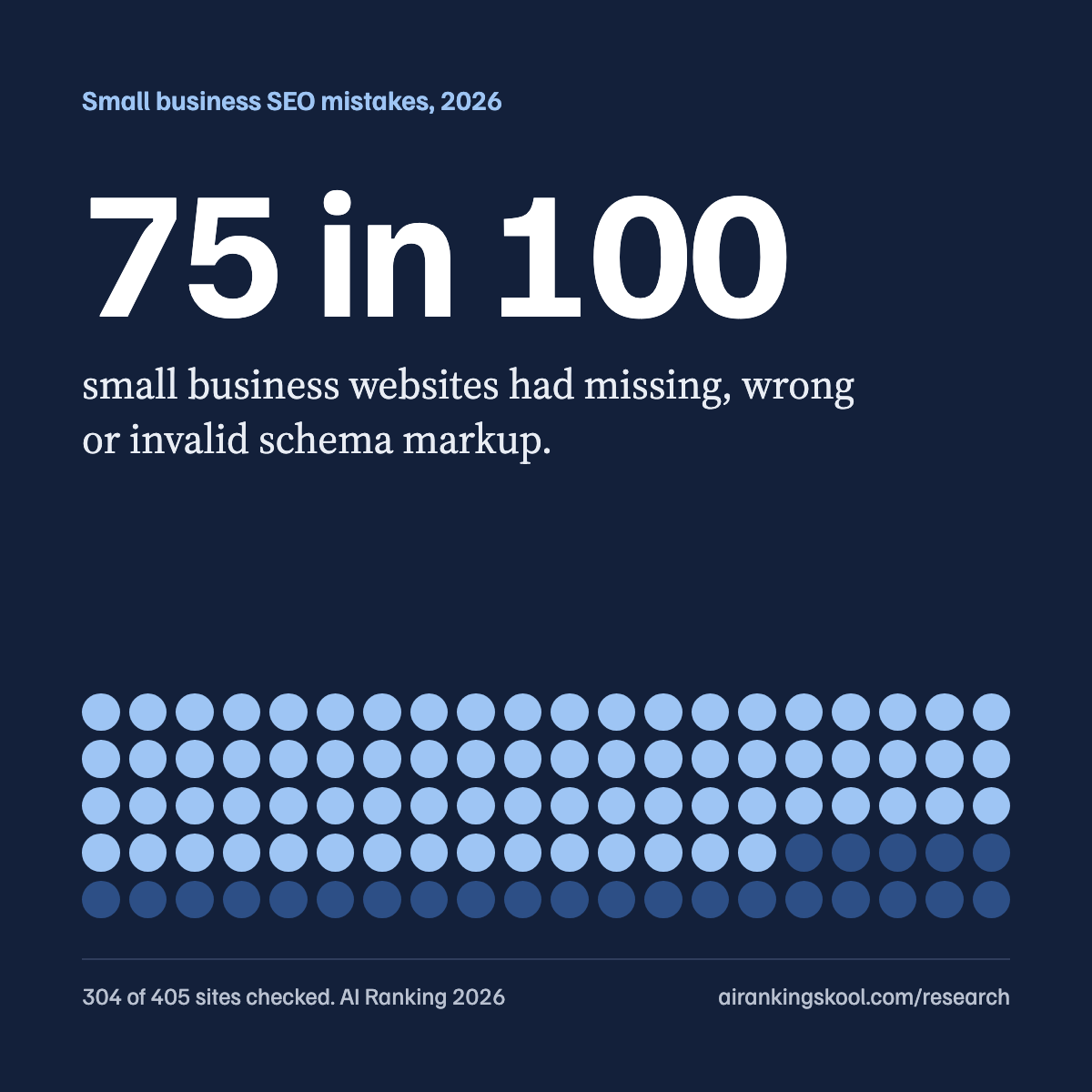
Three in four sites had missing or broken schema markup (304 of the 405 sites where it was checked), the most common problem in the study.
- 70%
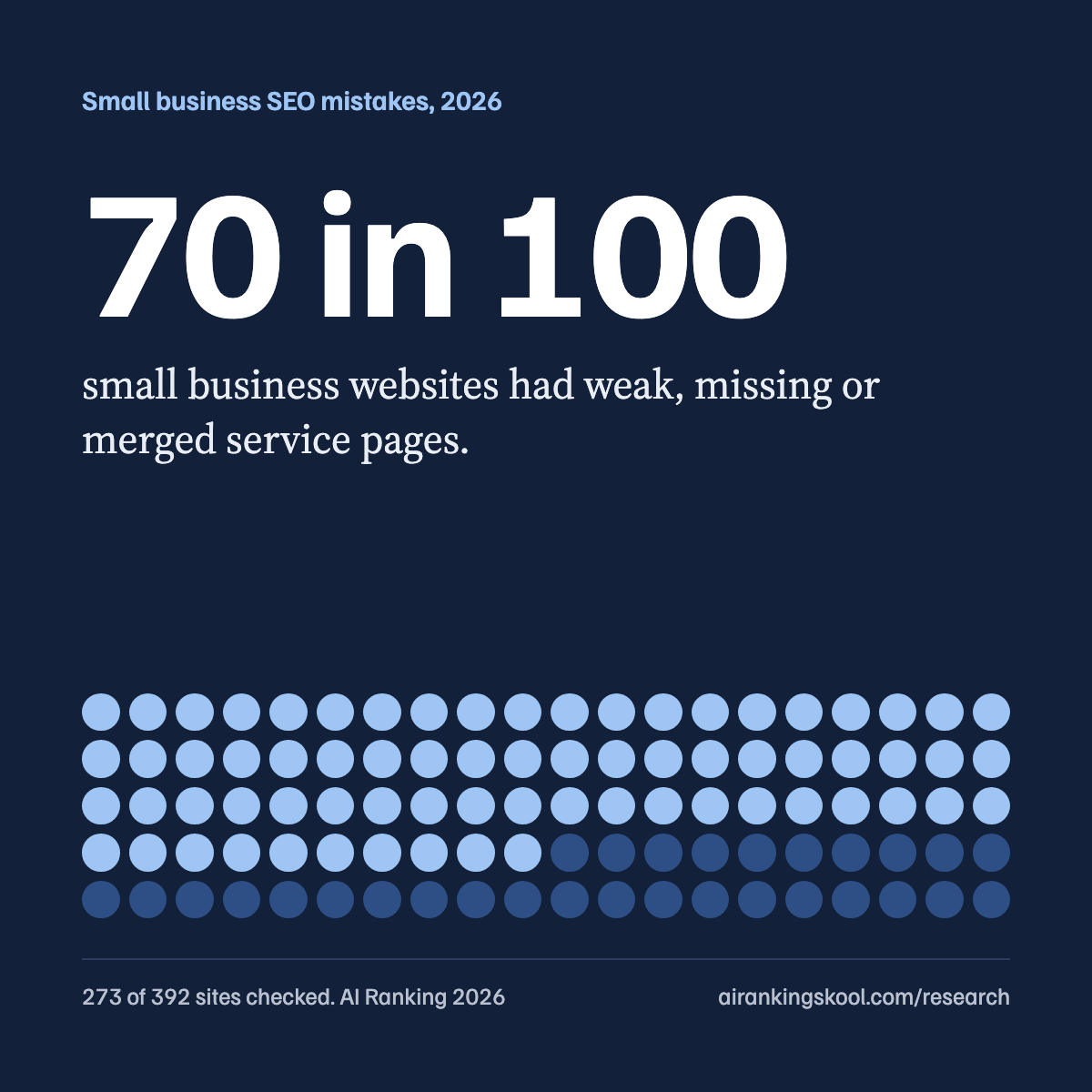
Seven in ten lacked proper service pages: services crammed onto one page, missing, or thin. It was the fix most often called top priority, on 192 sites.
- 7%
Mobile is solved. Structure is not. Only 7% had mobile layout problems, while 63% had title tag and meta description issues and 61% had heading problems.
- 73%
Money, health and legal sites lacked trust signals more often (73% against 56%), and the gap was flagged as high priority more than twice as often.
- 68%
Health and medical sites were the most likely to need significant work, against 39% of local service businesses and 39% of marketing agencies.
The numbers, ready to quote
Each statistic links to itself. Quote freely with a link back to this page.
- The median small business website we reviewed had 9 distinct SEO and conversion problems (439 websites, AI Ranking, 2026).
- Only 2.5% of small business websites (11 of 439) were rated strong with little to change (AI Ranking, 2026).
- 46% of small business websites (202 of 439) needed significant work, in the reviewer's overall assessment (AI Ranking, 2026).
- 75% of small business websites had missing, wrong or invalid schema markup (304 of 405 sites checked, AI Ranking, 2026).
- 70% of small business websites had weak, missing or merged service pages (273 of 392 checked), the problem most often called the top priority fix (AI Ranking, 2026).
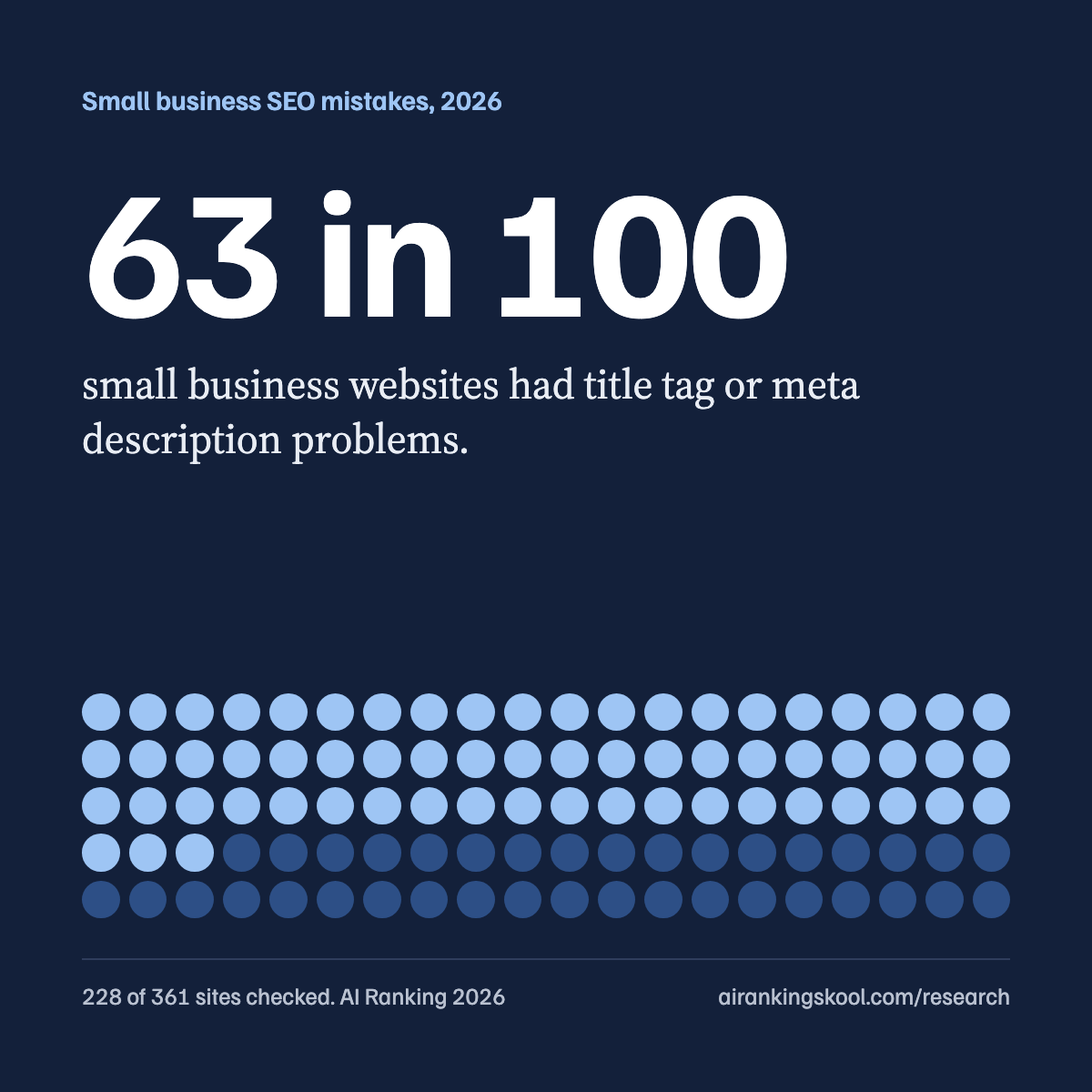
- 63% of small business websites had title tag or meta description problems (228 of 361 checked, AI Ranking, 2026).
- 61% of small business websites had H1 or heading problems, most often a slogan used where the keyword should be (194 of 318 checked, AI Ranking, 2026).
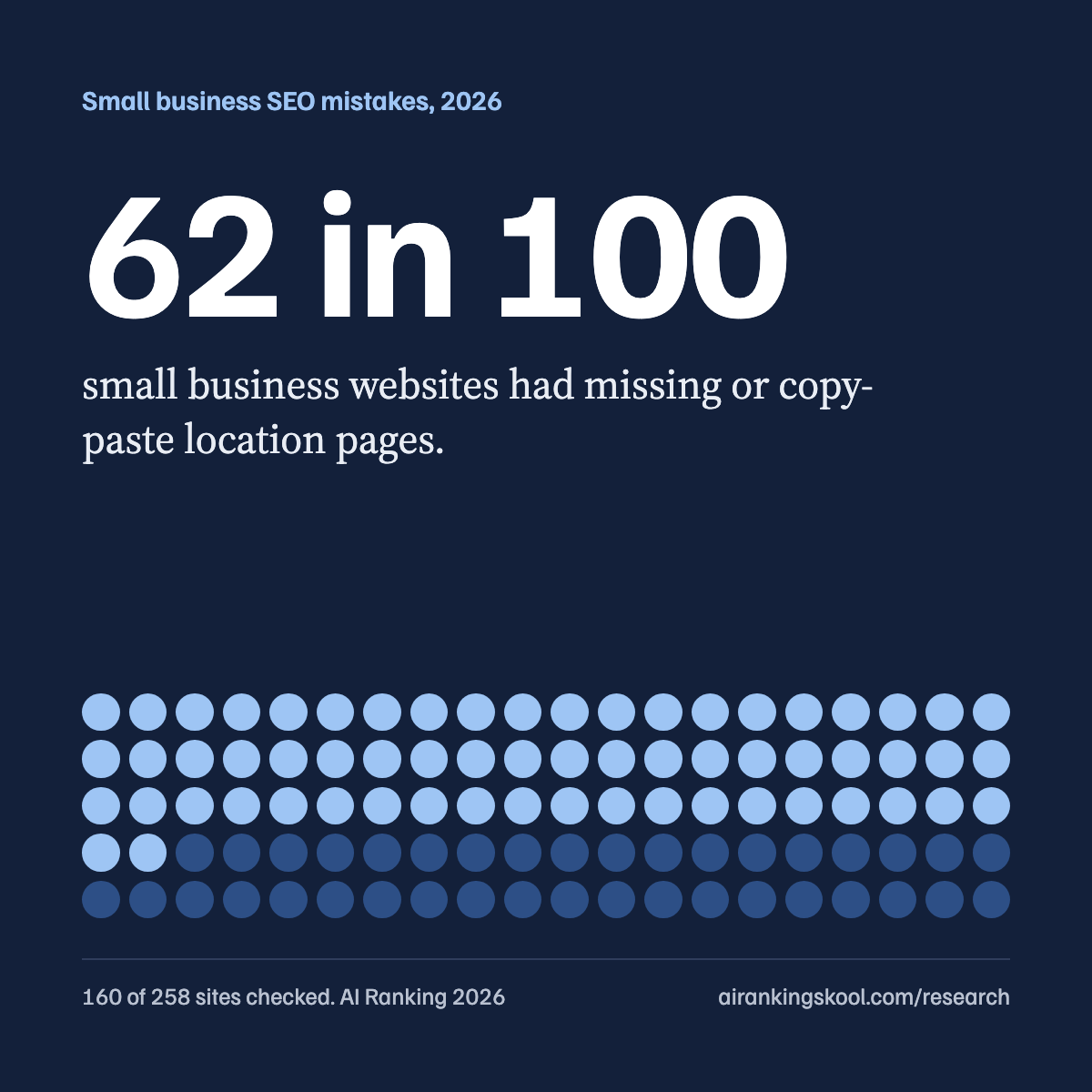
- 62% of local business websites had missing or near-duplicate location pages (160 of 258 where local search was reviewed, AI Ranking, 2026).
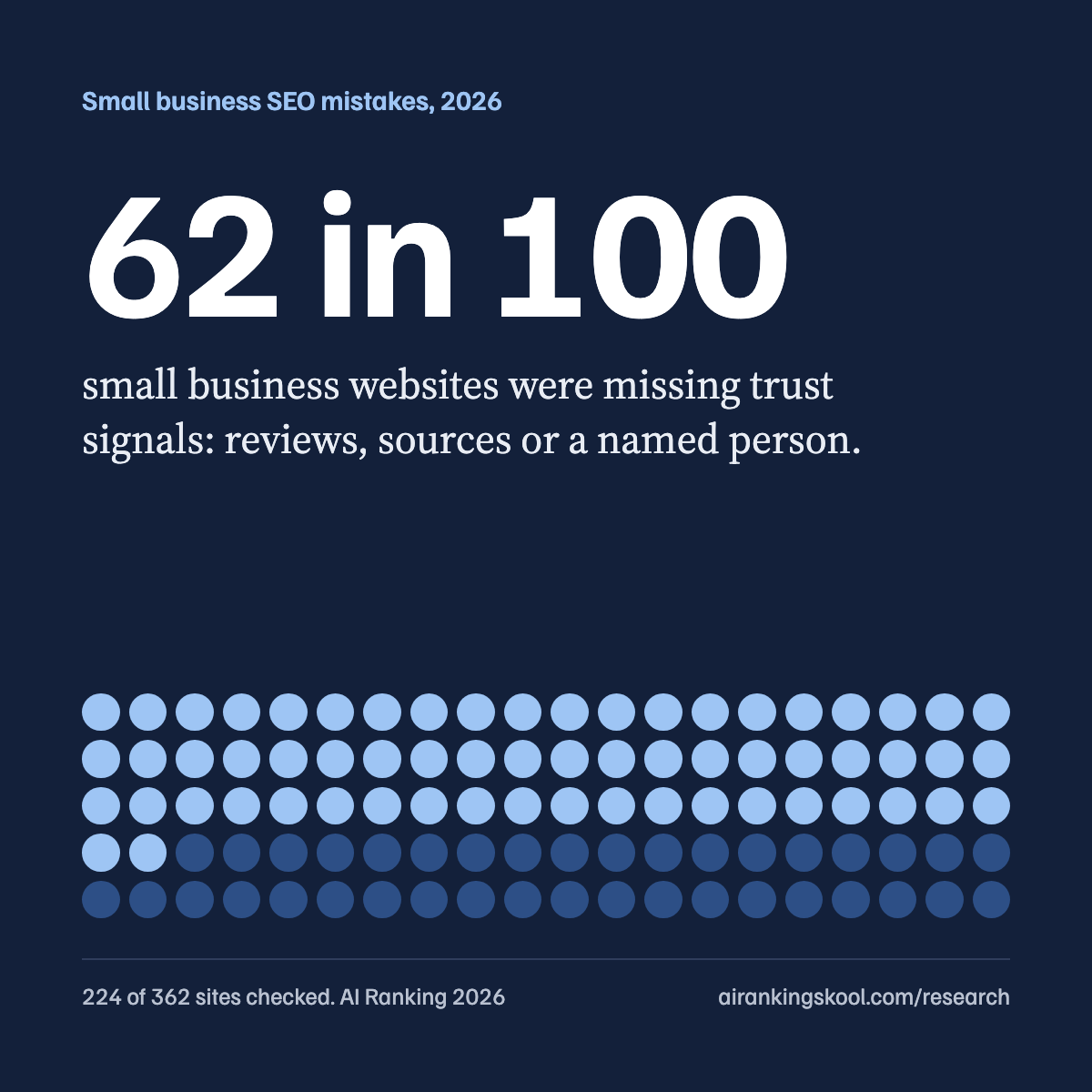
- 62% of small business websites were missing trust signals such as reviews, sources for claims or a named person (224 of 362 checked, AI Ranking, 2026).
- Health, money, legal and safety websites lacked trust signals 73% of the time against 56% for other sites, and the gap was called high priority 44% against 19% (AI Ranking, 2026).
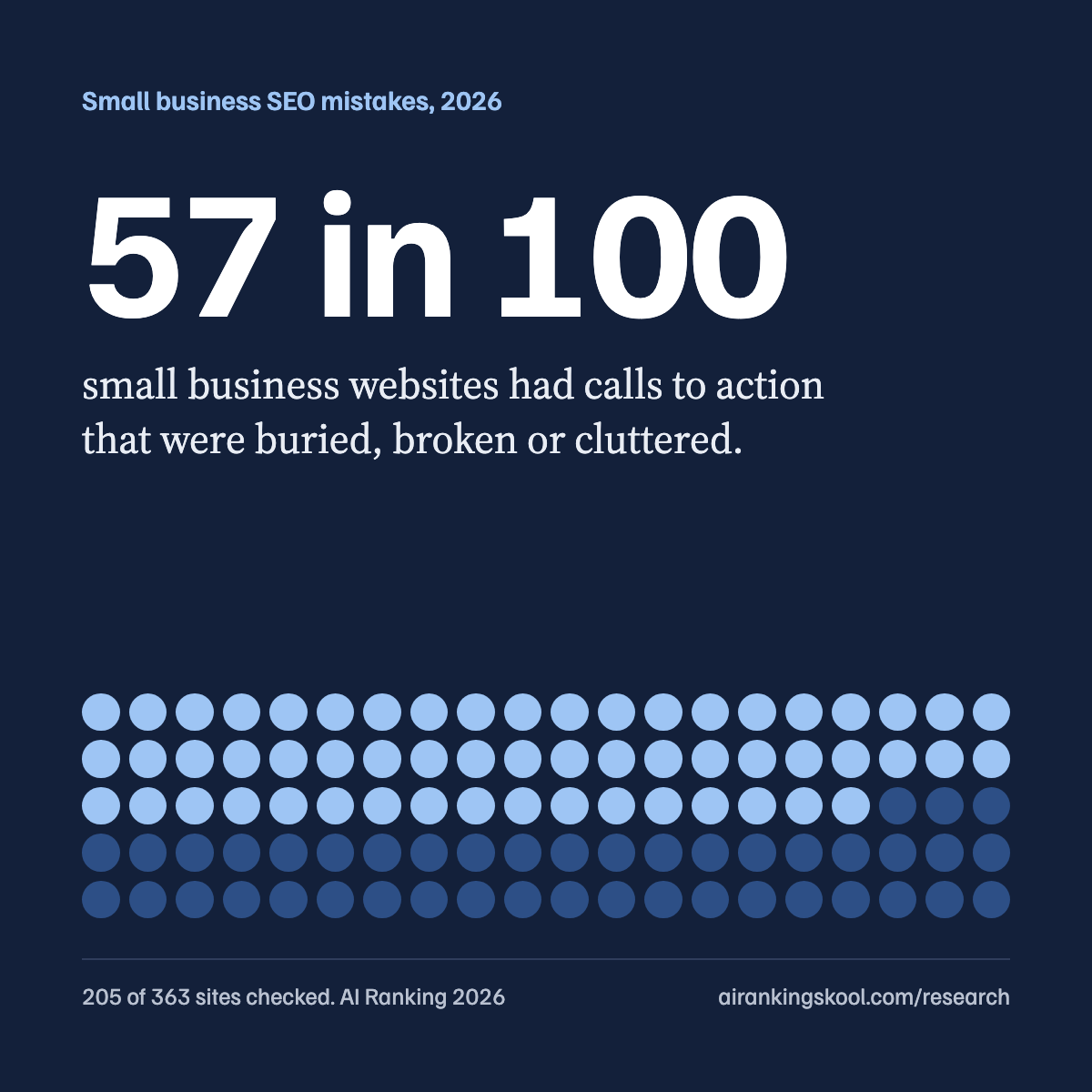
- 57% of small business websites had calls to action that were buried, broken or cluttered (205 of 363 checked, AI Ranking, 2026).
- 48% of small business websites failed the first impression test: a visitor could not tell within seconds what the business does, where, and what to do next (196 of 406 checked, AI Ranking, 2026).
- 54% of small business websites loaded slowly enough to be flagged (174 of 322 checked, AI Ranking, 2026).
- Only 7% of small business websites had mobile layout problems (27 of 406 checked): the remaining problems are structural, not technical (AI Ranking, 2026).
- 68% of health and medical websites needed significant work, against 39% of local service businesses and 39% of marketing agencies (AI Ranking, 2026).
- 95% of e-commerce websites had schema problems (37 of 39 checked, AI Ranking, 2026).
- 64% of the websites checked for indexing had indexing or technical errors (105 of 163, AI Ranking, 2026).
What we reviewed, why, and where
Every review in this report is a screen recording of Nico Gorrono going through a real, live website and saying what he would fix. The sites came from two places:
- 133 came from Find the Fix, a weekly public series where any business owner can submit a site for a review.
- 306 were member site reviews: owners, freelancers and agencies inside the AI Ranking community who asked for feedback on their own or a client's website.
Owners asked for a review because their site was not ranking, not converting, newly launched or about to be rebuilt. That makes this a sample of sites whose owners care about search, not a random sample of the web. These are the mistakes that survive even when someone is paying attention.
Each review starts with the first impression, then works through metadata, headings, speed, schema, content, service and location pages, trust signals and local search, using public tools such as GTmetrix, Google PageSpeed Insights and Google's Rich Results Test. In 88% of reviews (387) more than the homepage was examined.
Where the businesses operate
Country as stated or clearly implied in the review. 135 reviews did not make the country clear.
What kind of businesses
Business model of the site reviewed, all 439 sites.
What each review covered
Share of the 439 reviews in which each area was examined. Every rate in this report is calculated only over the sites where that area was actually checked.
When
Reviews recorded per month. Volume grew as the community did.
How often each problem showed up
The chart shows the share of sites with each problem, among the sites where that area was checked. The most common problems are not exotic technical failures. They are basic decisions about structure, labels and clarity that a website builder cannot make for you.
Areas checked on fewer than 150 sites are left out of the ranking because they were mostly examined when something already looked wrong: Google Business Profile gaps (45 of 59 checked) and weak backlink profiles (32 of 50). Full figures are in the data appendix.
What was most often called the top priority
Number of sites where the reviewer treated the problem as high priority (a fix to make first).
How many problems each site had
Number of sites by count of distinct problems recorded. Most sites had between 7 and 12. The coding recorded at most 12 problems per review, so the last bar means 12 or more.
One page cannot rank for ten services
This was the problem most often flagged as the first thing to fix. The usual pattern is a single "Services" page listing everything the business does. Each service then has no page of its own to rank for, and the services compete with each other.
The second pattern is service pages that read like blog posts: lots of explanation, no price range, no process, no proof and no button. Someone searching for a service is ready to buy, so the page should behave like it.
Illustrative example of the structure recommended in the reviews.
- A kitchen exhaust cleaning company in the UAE listed every service on one page.
- A law firm in Saudi Arabia grouped consultation, notary and dispute services together, so none could rank on its own.
- A business coach in Australia had service pages with no pricing, no process, no "who it's for" and no FAQs.
What to do
Build one page per service with a parent hub linking down to each. Give every page the service and location in its title and H1, a clear next step near the top, proof, and answers to the questions buyers ask. Local SEO guide
Most sites don't tell machines what they are
Schema is the structured data that tells search engines and AI assistants what a business is, what it sells and where. It was the most common problem in the study.
The usual failures: a single generic block copied onto every page, Article markup on a service page, or LocalBusiness markup missing basic fields such as address and phone number, so it fails validation.
{
  "@type": "LocalBusiness",
  "name": "Brightside Plumbing"
  "telephone"    missing
  "address"      missing
  "image"        missing
  "priceRange"   missing
} {
"@type": "Plumber",
"name": "Brightside Plumbing",
"telephone": "+1 512 555 0142",
"address": { ... Austin, TX },
"areaServed": ["Austin", "Round Rock"],
"aggregateRating": { 4.9, 210 }
} Illustrative example. Add Service, Person and FAQ markup on the pages they describe.
- A plumber in California had LocalBusiness schema that failed validation: no name, image, phone number, price range or address.
- A digital marketing agency in Australia had only organization schema, with no service or review markup.
- A supplements store in Italy had little or no schema at all on its collection pages.
What to do
Match the markup to each page: LocalBusiness or Organization site-wide, Service on service pages, Person for owners and authors, FAQ where there are FAQs, and review markup where reviews are shown. Then run every template through a schema validator. Technical SEO audit guide
The tagline trap
The single most repeated mistake was using a slogan where the keyword should be. A slogan tells a searcher and a search engine nothing about the service or the location.
The other common faults: titles that are just the brand name or "Home", several H1 tags on one page or none at all, and meta descriptions that are missing, cut off or have no reason to click.
Illustrative search results. The same rule applies to the H1: one per page, naming the service. Preview your own with the free SERP preview tool.
- An accounting firm in Australia used its slogan as the main heading instead of the service it wanted to rank for.
- A pediatric dentist in California had several H1 tags on the homepage.
- A garage door company in Texas used its tagline as the page title rather than the service and town.
What to do
Write titles as service plus location first, brand last. Use one H1 per page that names the service and keep the tagline as a subheading. Write meta descriptions of roughly 150 characters that end with a reason to click. SEO audit checklist
Copying a page and changing the town name doesn't work
The problems split into two opposite mistakes. Many businesses had no page for the areas they serve, so they could not rank there. Others had dozens of near-identical pages where only the town name changed, which search engines tend to merge or ignore.
The working rule of thumb from the reviews: each location page should be substantially different, around half its content or more, with genuinely local detail.
Plumber in Round Rock
Plumber in Cedar Park
Plumber in Round Rock
Recent jobs in Round RockOlder homes: pipe replacementReviews from Round RockMap and response timePlumber in Cedar Park
Hard water and softenersNew builds: warranty workReviews from Cedar ParkMap and response timeIllustrative example. Shared sections are fine; most of each page should be specific to the place.
- An invoice finance company in Texas had area pages that only swapped the place name and a few landmarks.
- A psychology practice in Australia targeted the whole country in its metadata, too broad to rank anywhere locally.
- A holiday rental site in Spain wrote its town pages as travel guides instead of listing the rentals in each town.
What to do
Create an "areas we serve" hub and a page per area that matters. Make each one different: local jobs done, travel time, local conditions, a map, reviews from that area and local schema. Free local page generator
Health, money and legal sites have the most to prove, and prove it least
The gap was widest where it matters most. On sites covering health, money, legal or safety topics, trust problems showed up 73% of the time against 56% for other sites, and were called a high priority fix 44% of the time against 19%.
- A medical clinic in India made health claims on its blog with no source behind them.
- A life insurance broker in Canada quoted national statistics without naming where they came from.
- An orthopedic surgeon in Singapore had no patient testimonials on any service page.
What to do
Show the people: owner or practitioner name, photo, credentials and a linked profile, with Person schema. Put an author bio on every article. Link each statistic to its original source, next to the claim. Show recent reviews where buyers decide. Generative engine optimization guide
Ranking is half the job
A site that ranks but doesn't turn visitors into enquiries has still failed. Nearly half the sites (48%) also failed the first impression test: within a couple of seconds a visitor should know what the business does, where, and what to do next.
The opposite failure is common too: rotating banners, pop-ups and competing buttons, so the visitor chooses nothing.
Illustrative first screen of a homepage: the two-second test.
- A marketing agency in the UK had "book a consultation" buttons that did nothing when clicked.
- An engineering consultancy in the UK had no call to action on its service pages. The only button was "view case studies".
- A pet products store in Australia opened with a tagline and a discount code, leaving visitors unsure what to buy.
What to do
One primary action, visible without scrolling, in a contrasting colour, on every service page. Click every button yourself. Cut rotating banners down to one message.
Who struggles most
Share of sites in each group that the reviewer judged to need significant work. Groups with at least 30 sites.
The three most common problems in each group
| Business type | Sites | Median issues | Most common problems |
|---|---|---|---|
| Local service | 132 | 9 | Missing or duplicate location pages (75%) Weak or missing service pages (75%) Schema markup missing or wrong (66%) |
| Marketing or web agency | 85 | 9 | Weak or missing service pages (78%) Schema markup missing or wrong (75%) Indexing and technical errors (68%) |
| Professional service | 65 | 9 | Schema markup missing or wrong (79%) Weak or missing service pages (75%) Missing trust signals (reviews, sources) (67%) |
| E-commerce | 44 | 11 | Schema markup missing or wrong (95%) H1 and heading problems (83%) Title tags and meta descriptions (73%) |
| Health or medical | 31 | 10 | Missing trust signals (reviews, sources) (82%) Schema markup missing or wrong (79%) Weak or missing service pages (79%) |
| Education or coaching | 21 | 10 | H1 and heading problems (87%) Thin content (71%) Title tags and meta descriptions (68%) |
By country
The three largest country groups. Problems were remarkably consistent across markets: schema and service pages lead almost everywhere.
| Country | Sites | Median issues | Most common problems |
|---|---|---|---|
| United States | 110 | 9 | Schema markup missing or wrong (70%) Missing or duplicate location pages (68%) Weak or missing service pages (66%) |
| Australia | 56 | 11 | Schema markup missing or wrong (84%) Title tags and meta descriptions (74%) Indexing and technical errors (70%) |
| United Kingdom | 37 | 9 | Indexing and technical errors (80%) Schema markup missing or wrong (71%) Slow loading (65%) |
If you only do ten things, do these, in this order
The sites that came out best had a homepage that says what, where and what next in the first screen; a dedicated, well-linked page for each service and area; real people on the site; recent reviews close to the call to action; and schema that validates. None of these needs a large budget. They need decisions made before the design.
- Pass the two-second testSay what you do, where, and what to do next in the first screen of the homepage.
- Give every service its own pageA hub that links to one page per service, written for someone ready to buy.
- Fix titles and H1sService plus location in the title and the H1. Brand last. Tagline as a subheading.
- Add and validate schemaLocalBusiness or Organization, Service, Person, FAQ and reviews, matched to each page.
- Put one clear call to action high on every service pageAnd click it to make sure it works.
- Show who is behind the businessNames, photos, credentials, author bios and Person schema.
- Source every claimLink statistics and health or money claims to the original source, next to the claim.
- Build location pages that are genuinely differentLocal detail, local proof, a map. Never a copy with the town name swapped.
- Make it fastConvert images to WebP, compress or remove heavy video, and test on mobile.
- Check what Google has indexedUse Search Console, fix pages that are crawled but not indexed, and link blog posts to service pages.
Frequently asked questions
What is the most common SEO mistake on small business websites?
Missing, wrong or invalid schema markup: 75% of the sites we checked had it (304 of 405). Weak or missing service pages came a close second at 70%, and was the problem most often called the first thing to fix.
How many SEO problems does a typical small business website have?
The median site in our review had 9 distinct problems worth fixing, and most had between 7 and 12. Only 11 of 439 sites were rated strong with little to change.
Do small business websites still have mobile problems?
Rarely. Only 7% had mobile layout problems. Modern website builders have largely solved mobile; the common problems are structure, titles and headings, schema and clarity.
Which kinds of businesses have the weakest websites?
Health and medical sites were the most likely to need significant work (68%), followed by e-commerce (52%). Local service businesses (39%) and marketing agencies (39%) did better.
What should a small business fix first on its website?
Make the homepage pass the two-second test (what, where, next step), give every service its own page, then fix titles and H1s so they name the service and location. Those three changes address the problems flagged as top priority most often.
How was this data collected?
Nico Gorrono reviewed 439 live websites on camera between 25 October 2025 and 29 October 2026 (133 Find the Fix episodes and 306 member reviews). Each transcript was coded into 23 problem categories and checked against the recordings. Rates are calculated only over the sites where each area was examined.
Take the report with you
The full PDF
The complete report in 15 pages, with every chart and the method. Free, no sign-up.
Download the PDFThe data (CSV)
All 23 problem categories: sites with the problem, sites checked, rate and high priority share. Licensed CC BY 4.0.
Download the CSVMachine-readable version
The full report as Markdown, for AI agents, researchers and anyone who wants plain text.
Open the MarkdownChart images for articles and slides
Free to use in articles, posts and presentations with a link back to this page.
How to cite this report
Gorrono, N. (2026). What's really wrong with small business websites: findings from 439 website reviews. AI Ranking. https://airankingskool.com/research/small-business-seo-mistakes/You are welcome to quote, chart and republish these findings with a link back to this page.
How the videos became data
Source. 439 screen-recorded website reviews made between 25 October 2025 and 29 October 2026 (133 Find the Fix episodes, 306 member reviews). Every review was recorded and transcribed in Tella. Videos shorter than two minutes were excluded.
Coding. Each transcript was coded with a language model (Claude Haiku) into a fixed set of 23 problem categories, each with the fix described and a priority (high, medium or low) as expressed by the reviewer. A second pass recorded the business type, the country, the areas examined and the reviewer's overall assessment. The coding instructions required that only problems and fixes the reviewer actually stated be recorded.
Checks. Two quality checks compared coded records with the full transcripts. In the first (12 reviews), no record was materially wrong and roughly 3 to 5% of individual claims were imprecise, most often a fix described in more detail than the reviewer gave. The instructions were tightened and every review was recoded. In the second (15 reviews), business type was about 93% accurate; country was correct in about 93% of cases but inferred rather than stated in around 40%; the overall assessment matched in about 75% of cases. Measurements read out during reviews (load times, scores) were too sparse and inconsistent to report.
Calculation. At most 12 problems were recorded per review, so the total of 4,043 is a floor. Every rate counts a site once per category and is calculated over the sites where that area was examined, not over all 439. Areas examined on fewer than 150 sites are reported separately because they were mostly checked when a problem was already suspected.
Limitations. The sample is self-selected: owners who asked for a review, many of them in an SEO community, and more agencies than the general population. One reviewer did every review, which keeps the method consistent but means the categories reflect one practitioner's standards. A problem not mentioned is not proof it was absent. Treat the rates as how often an experienced reviewer flags each problem on sites like these, not as a census of the web.
Data appendix: every problem category
| Problem | Sites with problem | Sites checked | Rate | High priority |
|---|---|---|---|---|
| Google Business Profile gaps * | 45 | 59 | 76.3% | 25.4% |
| Schema markup missing or wrong | 304 | 405 | 75.1% | 39.3% |
| Weak or missing service pages | 273 | 392 | 69.6% | 49.0% |
| Indexing and technical errors | 105 | 163 | 64.4% | 28.8% |
| Weak backlink profile * | 32 | 50 | 64.0% | 28.0% |
| Title tags and meta descriptions | 228 | 361 | 63.2% | 26.6% |
| Missing or duplicate location pages | 160 | 258 | 62.0% | 30.2% |
| Missing trust signals (reviews, sources) | 224 | 362 | 61.9% | 28.2% |
| H1 and heading problems | 194 | 318 | 61.0% | 27.7% |
| Calls to action buried, broken or cluttered | 205 | 363 | 56.5% | 33.3% |
| Thin content | 239 | 433 | 55.2% | 19.9% |
| Slow loading | 174 | 322 | 54.0% | 29.5% |
| Unclear first impression | 196 | 406 | 48.3% | 17.5% |
| No visible owner, team or author | 160 | 362 | 44.2% | 17.7% |
| Wrong or vague keyword targeting | 169 | 433 | 39.0% | 18.2% |
| Weak social proof and portfolio | 134 | 362 | 37.0% | 3.0% |
| Low-quality blog content | 153 | 433 | 35.3% | 13.9% |
| Vague positioning | 128 | 406 | 31.5% | 16.7% |
| Weak internal linking | 103 | 392 | 26.3% | 7.1% |
| NAP and citation issues | 36 | 258 | 14.0% | 2.7% |
| Poor site architecture | 38 | 392 | 9.7% | 4.3% |
| Mobile problems | 27 | 406 | 6.7% | 3.7% |
| No conversion tracking | 15 | 363 | 4.1% | 2.2% |
Want help fixing these on your own site?
AI Ranking members learn to fix every problem in this report with AI tools, and can submit their site for a review.