What Google AI Mode and Search Agents Mean for SEO
Google AI Mode and Search agents change SEO from only winning clicks to earning citations, recommendations and leads. This guide explains what changed and what to do now.
Google announced a bigger shift than another search feature: AI Mode and Search agents turn Google from a page of links into a system that can answer, compare, plan, book and take action for users. The old goal was simple: rank, win the click, then convert the visitor. The new goal is broader: rank where it still matters, get cited when AI answers the query, and give search agents enough clear information to recommend you instead of a competitor.
This does not mean SEO is dead. It has apparently been dying for years, and yet here it is, still making or breaking where people find your business. What it does mean is that weak SEO has fewer places to hide. Google has said its AI features are still rooted in its core Search ranking, indexing and quality systems, so the fundamentals still matter. What changes is the shape of the query, the scoreboard and the amount of detail your website needs to expose.
What changed with Google AI Mode?
Google AI Mode changes search from a box that returns links into an assistant that can reason through a task. In its Google I/O 2026 Search update, Google described Search agents, agentic booking, more personal context and a larger AI-powered Search box that can handle complex needs instead of short keyword-style searches.
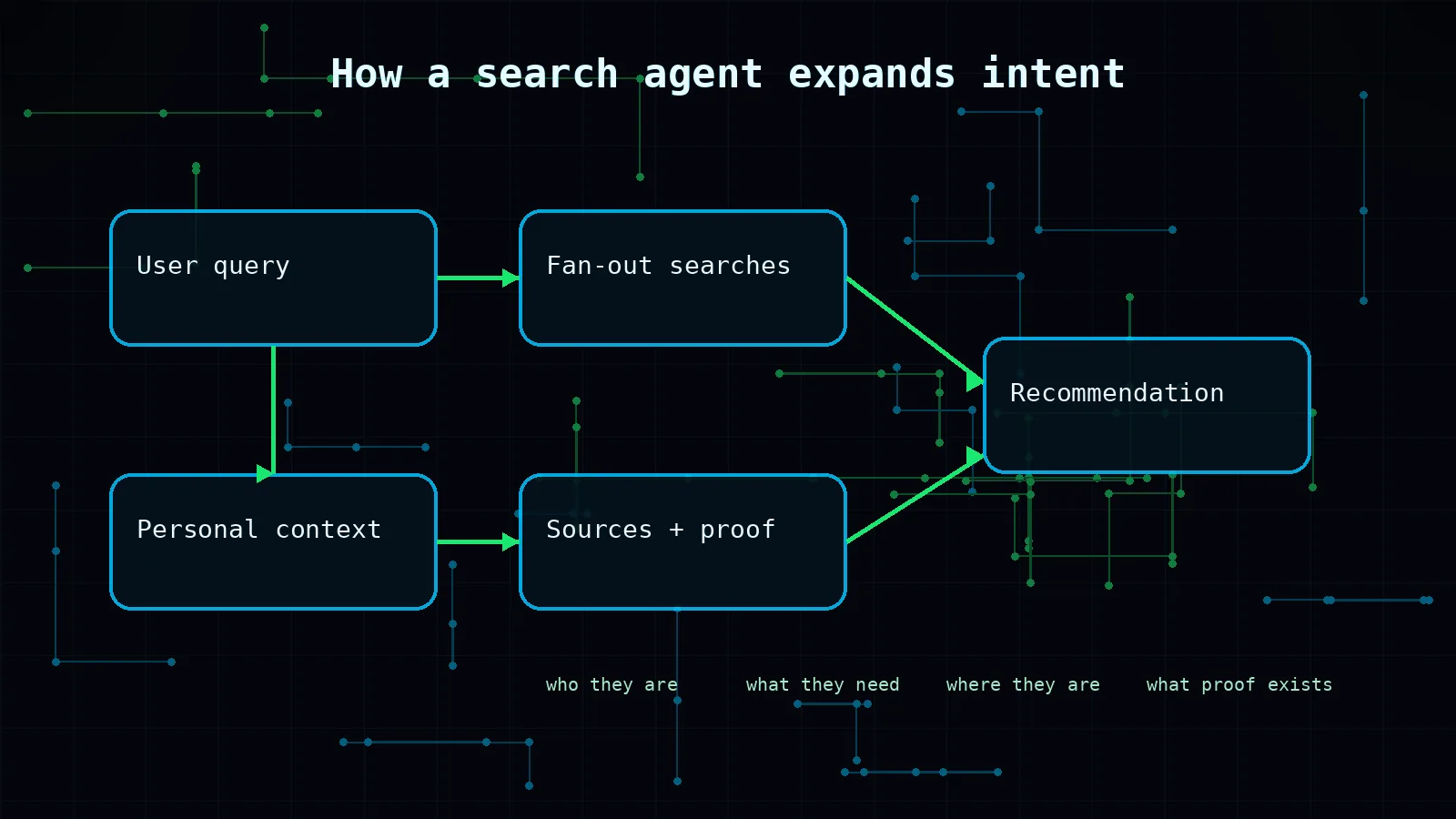
That matters because users no longer need to type one clean keyword like accountant near me. They can ask for a specific outcome, and the agent can fan out into many related searches, compare options and bring back a recommendation.
The mental model: your customer now has a concierge
The simplest way to think about search agents is this: your customer now has a concierge. That concierge knows more about what the user wants, asks more specific questions and filters options before the user ever lands on your site.
Imagine someone owns a 12-person Vietnamese restaurant in Fitzroy and asks Google to find an accountant. The agent is unlikely to think only in terms of accountant near me. It can look for something more like: accountant for a 12-person hospitality business in Fitzroy, using Xero, with roughly $1.8 million in revenue, who prefers in-person meetings.
That is the SEO shift. You are no longer only optimizing for broad keywords. You are making sure your website contains the specific evidence an AI system needs to decide, "this business is the right match".
What changed: old Google Search vs AI Mode
The fundamentals are still the base layer. But the way those fundamentals get used is changing.
| Old SEO focus | AI Mode and Search agents focus | What to do now |
|---|---|---|
| Rank for one target keyword | Show up across the query fan-out | Cover the main query, related sub-questions, comparisons and edge cases. |
| Win the click | Win the citation and the recommendation | Write answer-first sections that AI systems can quote and trust. |
| Generic service pages | Specific service and location evidence | Use one page, one service, one search intent, then add real location and audience detail. |
| Traffic reports only | Traffic plus AI visibility | Track clicks, citations, cited pages, grounding queries and leads. |
| Website as a brochure | Website as a business data API | Expose services, locations, FAQs, proof, pricing context, schema and clear CTAs. |
Clicks are no longer the only scoreboard
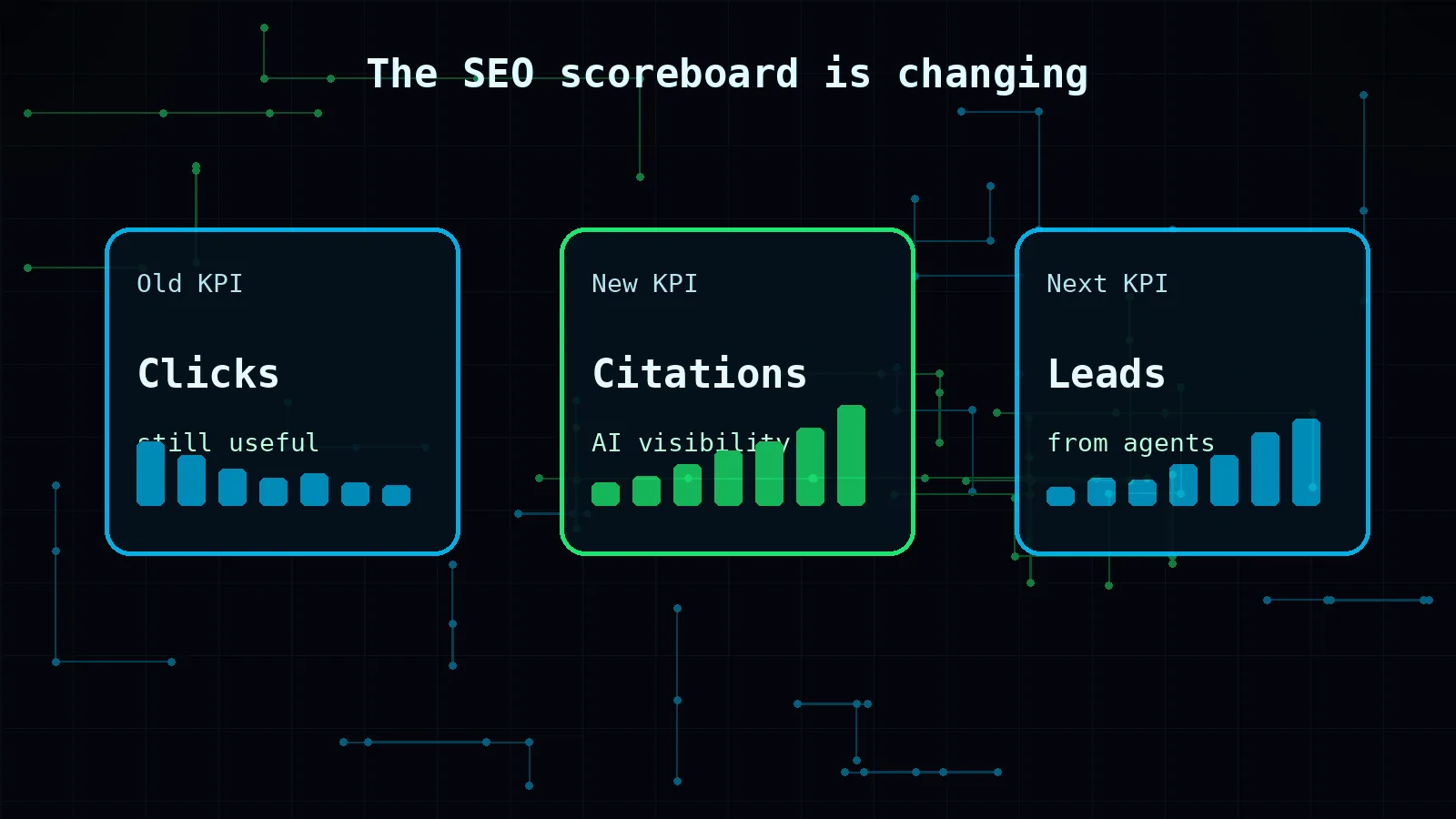
If your impressions are rising but clicks are falling, that does not automatically mean your SEO is failing. It may mean Google is answering more of the query before the user reaches your website.
This is why I would not only look at clicks anymore. Clicks still matter because leads and sales still matter. But you also need to watch where your content is being cited, which pages are used as sources and what queries trigger those citations.
Microsoft is already moving this way with its AI Performance report in Bing Webmaster Tools, which shows citation activity, cited URLs and grounding queries across Microsoft Copilot, Bing AI summaries and partner integrations. That is the direction the reporting layer is heading.
How to optimize for search agents
The practical work is not as mysterious as people make it sound. Google says there are no special technical requirements to appear in AI Overviews or AI Mode beyond being indexed, eligible for Search and eligible to show a snippet. But that does not mean you should do nothing. It means the work is still SEO, just with more specificity.
| Area | Why it matters for AI Mode | Practical action |
|---|---|---|
| Indexing | Google's AI features pull from the Search index. | Make sure important pages are crawlable, indexed and not blocked by noindex or snippet restrictions. |
| Page structure | Agents need to understand what each page is about. | Use clear H1s, H2s, FAQs, internal links and one intent per page. |
| Specificity | Agents compare detailed user needs against detailed business data. | State services, locations, software, industries, audience types, pricing context and constraints where relevant. |
| Proof | AI systems need reasons to trust the recommendation. | Add reviews, examples, case studies, screenshots, results and first-hand experience. |
| Schema | Structured data helps clarify entities and page purpose. | Use relevant Organization, LocalBusiness, Service, Product, FAQ or Article schema where appropriate. |
| AI visibility | Traffic alone misses zero-click and citation behavior. | Track citations, cited pages, grounding queries and AI Overview visibility in tools like DataWise and Bing Webmaster Tools. |
Query fan-out changes how you plan content
Google says AI Overviews and AI Mode may use query fan-out, where the system issues multiple related searches across subtopics and data sources to build a better answer. This is why one shallow blog post is usually not enough.
If you want to rank for a topic like local SEO, you need pages that answer the surrounding questions too: Google Business Profile, citations, reviews, service pages, location pages, schema, images, speed and conversion. That is also why topical authority still matters.
This is where query fan-out research becomes useful. In DataWise, the goal is not just to find one keyword. It is to see the cluster of questions around that keyword so you can decide what deserves a service page, what deserves a blog post and what should be answered inside an FAQ.
Your website needs to become a business data API
A lot of websites are still built like brochures. They look decent, but they do not give search engines enough clean information to understand the business.
For this new version of Google Search, your website needs to clearly expose:
- what you do
- who you do it for
- where you do it
- what makes you qualified
- what proof you have
- what the user should do next
- what questions buyers usually ask before they convert
That is why I keep coming back to site structure. If all your services are buried on one generic services page, you are making the agent guess. A cleaner approach is one page, one service, one search intent, then support those pages with helpful informational content.
Do you need llms.txt?
Yes, I would add an llms.txt file. Not because it is a confirmed Google Search ranking factor, but because Google Chrome Developers now includes llms.txt in Lighthouse's experimental Agentic browsing audits. Their documentation describes llms.txt as an emerging convention that gives LLMs and AI agents a machine-readable summary of your website, and says that without it, agents may spend more time crawling the site to understand its structure and primary content.
The nuance matters. Google Search Central says there are no extra technical requirements for appearing in AI Overviews or AI Mode beyond being indexed and eligible for a snippet. So I would not sell llms.txt as a magic AI ranking switch. I would treat it as an agent-readiness file: a simple way to make your best pages, services, products, policies and resources easier for AI systems to understand.
If you are on WordPress, this is not a developer project anymore. Yoast SEO can generate an llms.txt file automatically, and Rank Math has an LLMS Txt module you can enable from the plugin dashboard. For most business owners, freelancers and agencies, that is the easiest first step: turn it on, review what it includes, and make sure it points agents to the pages you actually want them to understand.
A practical 30-day plan
If I were adapting a site for Google AI Mode SEO, I would not start by chasing hacks. I would do this:
- Check indexability: make sure important pages are indexed, crawlable and eligible for snippets.
- Audit the money pages: make sure every core service has its own page with a clear intent.
- Add missing proof: reviews, examples, case studies, screenshots, process details and results.
- Map the fan-out: find the questions around each service and decide which ones need blog posts.
- Improve answer sections: rewrite key H2 sections so the first sentence answers the question directly.
- Add schema: use the right schema for the page type, but do not rely on schema alone.
- Track AI visibility: watch citations, AI Overview visibility, cited pages and leads, not just clicks.
What this means for business owners, freelancers and agency owners
For business owners, this means your website needs to explain the business clearly enough that an AI agent can recommend you. For freelancers, it means the work you sell should include structure, content, proof and conversion, not just pretty pages. For agency owners, it means reporting needs to expand beyond rankings and traffic.
The upside is that most competitors will not do this properly. They will either panic and say SEO is dead, or they will keep publishing generic blog posts that could have been written for any business. Both are weak strategies.
AI search does not remove the need for fundamentals. It raises the cost of weak structure.
If you want the guided version of this, the AI Ranking community teaches the SEO and AI search workflow step by step, with DataWise included so you can audit pages, research keywords, plan content and track AI visibility without jumping between five different tools.
FAQ
Is SEO dead because of Google AI Mode?
No. SEO is not dead. It has been declared dead so many times it should probably have its own funeral punch card, but Google's AI features still depend on crawling, indexing, ranking and quality systems. What is changing is that clicks are no longer the only measure of success. You also need to earn citations and recommendations inside AI-generated answers.
How do I optimize for Google AI Mode and Search agents?
Optimize by keeping your technical SEO clean, creating useful non-commodity content, structuring pages clearly, answering related questions, adding proof, using relevant schema and tracking AI visibility alongside traffic.
What is query fan-out in AI search?
Query fan-out is when an AI search system issues multiple related searches around a user's original question. This helps it gather subtopics, comparisons and supporting sources before generating an answer.
Should I still care about rankings?
Yes. Rankings still matter because AI search features are grounded in search systems. But rankings are now only one part of the scoreboard. You also need citations, visibility, proof and leads.