Build 4 AI SEO Systems That Help You Get Found in ChatGPT, Perplexity, Gemini, and Google
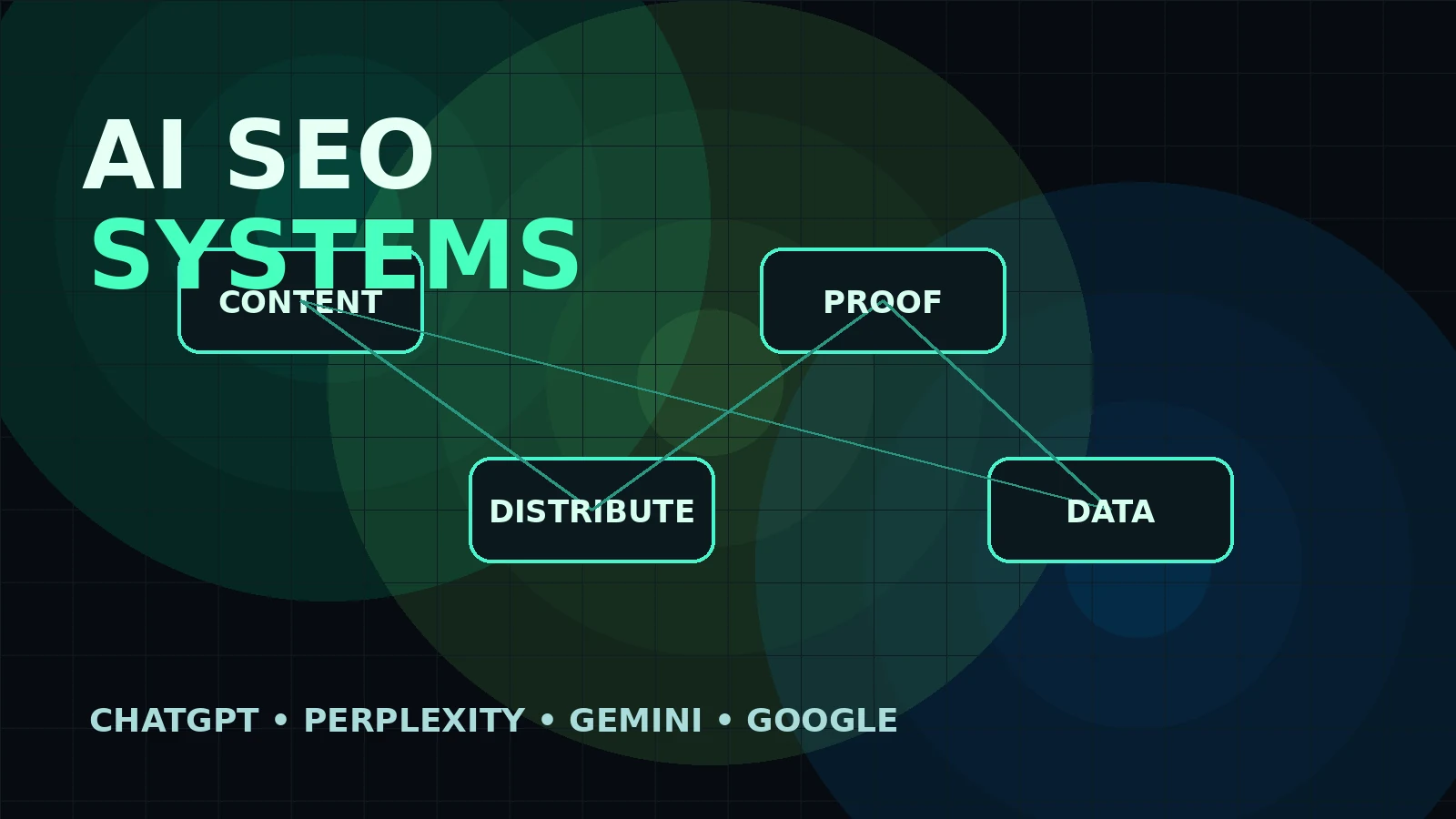
AI SEO is not one tactic. These four systems help business owners, freelancers, and agency owners create useful content, distribute it, prove trust, and improve based on performance.
Most people are thinking about AI SEO the wrong way.
They are asking questions like:
- How do I rank in ChatGPT?
- How do I show up in Perplexity?
- How do I optimize for Gemini?
- Is Google SEO dead?
Those are useful questions, but they are not the best starting point.
The better question is:
What systems does my business need so AI search engines can understand, trust, cite, and keep finding me over time?
Because AI SEO, GEO, LLM SEO, whatever you want to call it, is not one trick. It is not adding a paragraph to your homepage and hoping ChatGPT magically recommends you.
It is a combination of content, structure, authority, distribution, and measurement.
If you want to get found in ChatGPT, Perplexity, Gemini, and Google, you need systems that keep improving every week.
In this post, I’ll break down four AI SEO systems I’d build for almost any serious business.
Quick answer: the 4 AI SEO systems
| System | What it does | Why it matters |
|---|---|---|
| Content creation system | Turns customer questions into useful pages and posts | Gives Google and AI tools something worth citing |
| Distribution system | Repurposes content across GBP, LinkedIn, YouTube, email, and social | Helps content get discovered outside your website |
| Authority and proof system | Collects reviews, examples, case studies, screenshots, and real experience | Makes your business more trustworthy to humans and AI systems |
| Performance improvement system | Tracks what gets impressions, clicks, citations, leads, and rankings | Helps you improve based on data instead of guessing |
The businesses that win in AI search will not be the ones that publish random AI-written articles.
They will be the ones that build these systems and keep improving them.
System 1: The content creation system
The first system is content creation.
But not generic content creation.
I do not mean asking ChatGPT to write 50 blog posts about random keywords.
That is the fastest way to create a website nobody trusts.
A good AI SEO content system starts with real business knowledge:
- questions customers actually ask
- objections that stop people from buying
- examples from real projects
- comparisons customers care about
- local service pages people search for
- tutorials that show how you solve problems
- screenshots, data, or proof from your own work
AI can help you turn that into content, but the raw material should come from the business.
For example, if you are a local dentist, your content should not just say “Invisalign is a popular treatment option.”
That is generic.
A better article would answer the actual questions people ask before booking:
- Is Invisalign noticeable at work?
- Does Invisalign hurt?
- How long does it take?
- Is it better than braces for adults?
- What happens during the first appointment?
That kind of content is useful for Google, but it is also useful for AI search tools because it gives them clear, specific, answerable information.
This is why I like building content systems around owner input.
The AI should ask questions like:
- What do customers misunderstand about this service?
- What do you wish people knew before contacting you?
- What examples can we safely mention?
- What claims should we avoid?
- What makes your approach different?
Then it can turn those answers into content that sounds like the business, not like a generic AI blog.
If you want a starting point, read my guide on how to write content that ranks in AI search.
System 2: The distribution system
The second system is distribution.
Most businesses publish a blog post and stop there.
That is a mistake.
A good blog post can become:
- a Google Business Profile post
- a LinkedIn post
- a short-form video script
- an email newsletter
- a YouTube outline
- a FAQ section
- an internal link opportunity
- a sales resource
- a review request angle
This matters because AI search tools do not exist in a vacuum.
They learn from and cite the broader web. They look at websites, search results, authoritative pages, brand mentions, local profiles, reviews, and other sources they can access.
If your useful content only lives in one place, you are limiting its surface area.
For local businesses, Google Business Profile is especially important.
If you write a blog post about “How to choose an emergency dentist in Miami,” that can also become a GBP post that says:
Not every dental problem needs emergency care, but some symptoms should not be ignored. In our latest guide, we explain when to call an emergency dentist, what to expect, and how to avoid making the problem worse.
That is not revolutionary. It is just basic content repurposing.
But if you do it every week, it becomes a system.
The same applies to LinkedIn.
A business owner or agency owner can take one useful blog post and turn it into a practical LinkedIn post:
Most businesses do not have an SEO problem. They have a distribution problem. They write useful content once, publish it on the blog, and never turn it into GBP posts, LinkedIn posts, emails, videos, or sales assets.
That kind of post can build authority and send more signals back to the brand.
For AI SEO, distribution is not optional. It is how you create more places where your expertise can be found.
System 3: The authority and proof system
The third system is authority and proof.
This is where a lot of AI-generated SEO falls apart.
The content sounds fine, but there is no proof behind it.
No examples. No reviews. No screenshots. No results. No personal experience. No clear reason to trust the business.
Google has been pushing people toward helpful, trustworthy content for years. AI search makes that even more important because AI systems often need to decide which source is worth citing or summarizing.
A proof system should collect:
- customer reviews
- before and after examples
- screenshots
- case studies
- founder opinions
- project notes
- FAQs from real conversations
- testimonials
- local photos
- service-specific examples
- unique processes
This is especially important for local SEO.
If two roofers have similar service pages, but one has real photos, review patterns, local examples, service area proof, and clear explanations from the owner, that business has a much stronger foundation.
This does not mean stuffing every page with testimonials.
It means building a library of proof the content system can use.
For example:
Proof library:
- Reviews mentioning emergency response time
- Photos from recent roof repair projects
- FAQs from sales calls
- Common objections about pricing
- Local neighborhoods served
- Before/after examples
- Owner explanations of how estimates work
Then when you create a page, blog post, GBP post, or LinkedIn post, the AI can pull from real material.
That is how you avoid generic AI content.
System 4: The performance improvement system
The fourth system is performance improvement.
This is the system most businesses skip.
They publish content and never look at what happened.
A good AI SEO system should track:
- which pages get impressions
- which pages get clicks
- which queries are growing
- which posts get engagement
- which GBP posts get actions
- which content leads to enquiries
- which reviews mention specific services
- which pages have indexing problems
- which pages are ranking on page 2
- which content is being cited or mentioned in AI search tools where measurable
This is where tools like Google Search Console, GA4, GBP insights, Bing Webmaster Tools, and rank tracking become useful.
Not because you need a giant dashboard.
Because you need to know what to improve next.
For example:
| Signal | What it might mean | Action |
|---|---|---|
| High impressions, low CTR | Page is being seen but not clicked | Improve title and meta description |
| Ranking positions 8 to 20 | Google understands the page but it needs more strength | Improve content, internal links, proof, and topical support |
| GBP posts get views but no actions | Messaging may be weak | Test clearer calls to action |
| Blog gets traffic but no leads | Search intent may be informational | Add better internal links and next steps |
| Reviews mention one service repeatedly | Customers associate you with that service | Build more content around it |
This is the part where an AI agent becomes genuinely useful.
It can check the data every week, summarize what changed, and recommend the next actions.
Not as a replacement for strategy, but as a way to stop ignoring the data.
How these systems work together
The four systems are connected.
Content gives you useful assets.
Distribution gives those assets more surface area.
Proof makes the content believable.
Performance data tells you what to improve next.
That loop looks like this:
Customer questions
  -> useful content
  -> distributed across channels
  -> supported with proof
  -> measured in search and engagement data
  -> improved next month
That is the real AI SEO workflow.
Not “write more blogs.”
Not “ask ChatGPT for keywords.”
Not “optimize for one platform.”
Build the loop.
What this looks like for a local business
Let’s use a local service business as an example.
The business wants more leads from Google and AI search.
A weak approach would be:
Publish 20 AI-written blog posts about local SEO keywords.
A better approach would be:
- Interview the owner about their best services, customer questions, and local expertise.
- Build service pages that answer buying-intent searches.
- Turn real customer questions into blog posts.
- Repurpose those posts into GBP updates.
- Track reviews and extract recurring themes.
- Use those review themes as proof in future content.
- Monitor Search Console for pages gaining impressions.
- Improve pages ranking in positions 4 to 20.
- Share practical posts on LinkedIn or other relevant channels.
- Repeat every week.
That is not magic.
It is operations.
And that is exactly why AI agents are interesting for SEO.
They are not just writing assistants. They can become operators that keep the system moving.
What I would build first
If I were building this for a business owner, freelancer, or agency owner, I would start with a simple version:
- One business profile
- One content calendar
- One review tracker
- One GBP post workflow
- One blog performance tracker
- One weekly approval message
Do not start by trying to automate everything.
Start with the weekly loop:
What did we publish?
What did customers ask?
What reviews came in?
What pages got impressions?
What should we improve next?
What needs owner approval?
If your AI system can answer those questions every week, you are already ahead of most businesses.
Final takeaway
AI SEO is not about tricking ChatGPT, Perplexity, Gemini, or Google.
It is about building systems that make your business easier to understand, trust, cite, and recommend.
The four systems are:
- Content creation
- Distribution
- Authority and proof
- Performance improvement
Build those, and you are not just chasing the latest AI SEO tactic.
You are building an engine that can keep improving as search changes.
If you want the simple starting point, join the free AI Search Kickstarter. It gives you a practical starter workflow for improving how your site shows up in Google and AI search.
Want the starter workflow?
Join the free AI Search Kickstarter and get a practical starting point for improving how your site shows up in Google and AI search.